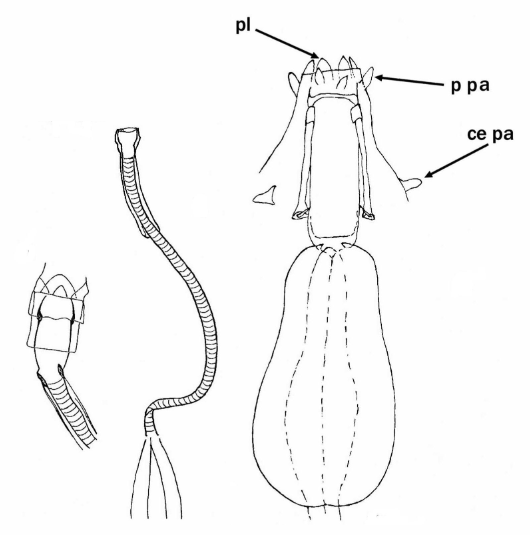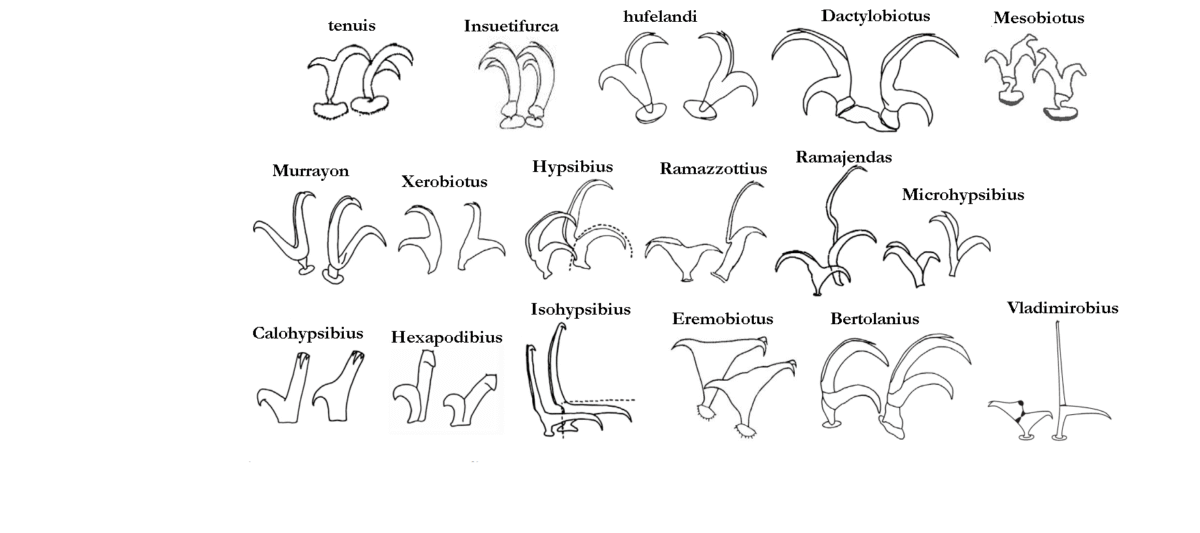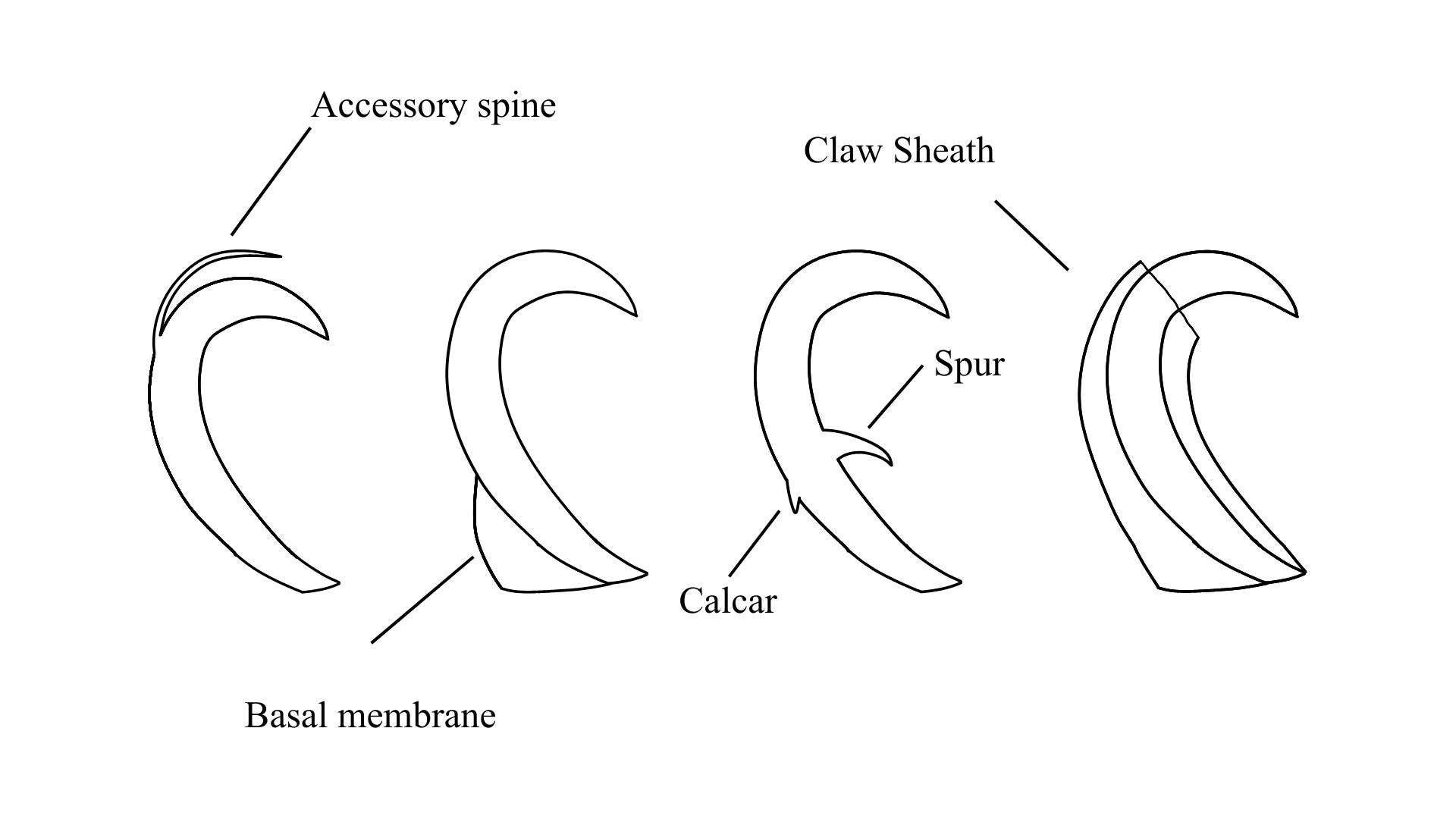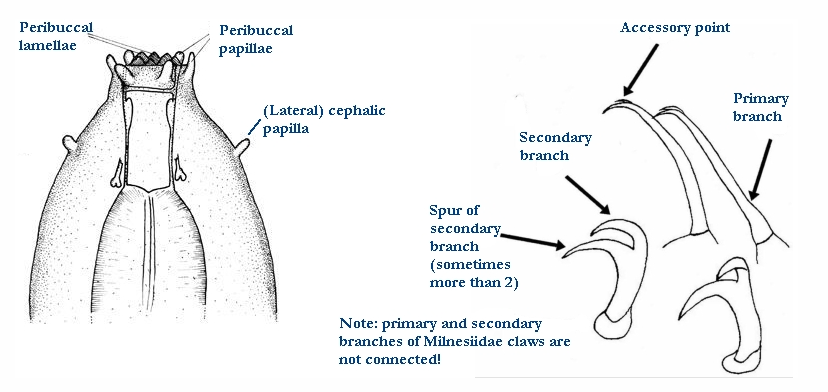

Genus description from Kaczmarek et al. 2020: “Legs long and slender. Claws of Vladimirobius type—internal claws at least two times shorter than the external claws (measured from the base of the claw), very wide at the junction of primary and secondary branches, short and thin basal part, primary branches with a very prominent gibbosity-like projection near the junction of primary and secondary branches (Figs 1, 3; arrowhead), accessory points connected close to the end of the primary branch; external claws very long (two times longer than the internal claws; measured from the base of the claw) and very thin (especially the primary branches) with long basal part, gibbosity-like projection near the base of primary branch absent, accessory points connected very near to the end of the primary branch (Figs 1, 5; arrow). Oral cavity armature present in the form of two bands of teeth (second—visible as small granules arranged in a few rows and third—a single row of larger granules). Microplacoid absent. The other characters typical for Isohypsibius (according to Pilato & Binda 2010 and Gąsiorek et al. 2019) i.e. smooth cuticle, bucco-pharyngeal apparatus of the Isohypsibius type, Isohypsibius variant, six peribuccal lobes present, peribuccal lamellae absent, pharyngeal apophyses and three macroplacoids present, pseudolunulae present, cuticular bars on legs I–III present near the base of the claw, smooth eggs laid in the exuvium.”


Citations:
Kaczmarek, Ł., Bartylak, T. & Roszkowska, M. (2020) Two new genera of long clawed Isohypsibioidea Guil, Jørgensen & Kristensen, 2019. Zootaxa 4729, 293–299.