Richtersius

Stec, D., Krzywański, Ł., Arakawa, K. et al. A new redescription of Richtersius coronifer, supported by transcriptome, provides resources for describing concealed species diversity within the monotypic genus Richtersius (Eutardigrada). Zoological Lett 6, 2 (2020).

Class: Eutardigrada

Order: Parachela

Superfamily: Macrobiotoidea

Family: Richtersiusidae

Click taxa for descriptions

Richtersia from Pilato & Binda 1987: “Macrobiotidae; tubo boccale rigido provvisto di sbarretta di rinforzo ventrale la cui porzione anteriore è rilevata a formare una cresta mediana assai pronunciata recante un vistoso processo ad uncino (*); dorsalmente la porzione anteriore del tubo boccale presenta una cresta mediana molto sviluppata con un processo ad uncino ancor più vistoso di quello ventrale. Furca degli stiletti come in Adorybiotus, ossia molto sviluppata e con i processi postero-laterali molto divergenti, tozzi, e non ingrossati all’apice. Bulbo faringeo provvisto di apofisi e di placoidi; lamelle periboccali presenti. Uova col guscio ornamentato.

(*) In realtà la porzione anteriore del tubo boccale ha una configurazione assai complessa, e in una determinata posizione di fuoco di uncini ventrali se ne contano due, ma soltanto quello più sviluppato appartiene realmente alla cresta ventrale.”

Translated with aid of Google Translate: Macrobiotidae; rigid buccal tube with ventral lamina whose anterior portion is raised to form a very pronounced median ridge bearing a conspicuous hooked process (*); dorsally the anterior portion of the mouth tube has a very developed median ridge with a hooked process even more conspicuous than the ventral one. Furca of the stylets as in Adorybiotus, i.e. very developed and with very divergent posterolateral processes, squat, and not enlarged at the apex. Pharyngeal bulb provided with apophyses and placoids; peribuccal lamellae present. Eggs with decorated shell.

(*) In reality the anterior portion of the buccal tube has a very complex configuration, and in a in a given plane of focus, two ventral hooks may be seen, but only the most developed one actually belongs to the ventral crest.

Renamed Richtersius by Pilato & Binda 1989.

Pilato, G. & Binda, M.G. (1987) Richtersia, nuovo genere di macrobiotidae, e nuova definizione di Adorybiotus Maucci e Ramazzotti, 1981 (Eutardigrada). Animalia, 14, 147-152.
Stec, D., Krzywański, Ł., Arakawa, K. et al. A new redescription of Richtersius coronifer, supported by transcriptome, provides resources for describing concealed species diversity within the monotypic genus Richtersius (Eutardigrada). Zoological Lett 6, 2 (2020).

Citations:

Pilato, G. & Binda, M.G. (1987) Richtersia, nuovo genere di macrobiotidae, e nuova definizione di Adorybiotus Maucci e Ramazzotti, 1981 (Eutardigrada). Animalia, 14, 147-152.

Pilato, G. & Binda, M.G. (1989) Richtersius, nuovo nome generico in sostituzione di Richtersia Pilato e Binda, 1987 (Eutardigrada). Animalia, 16, 147-148.
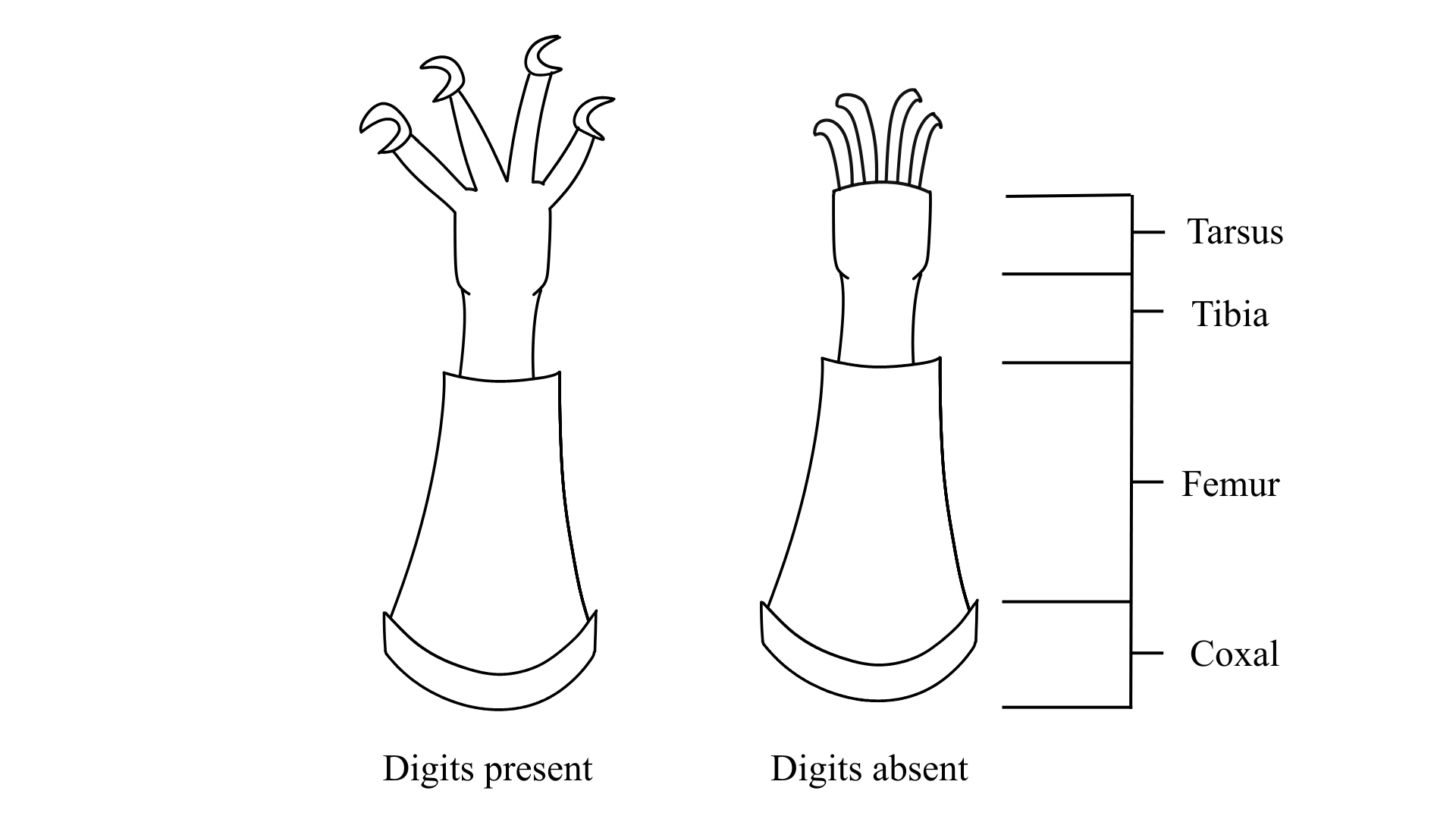
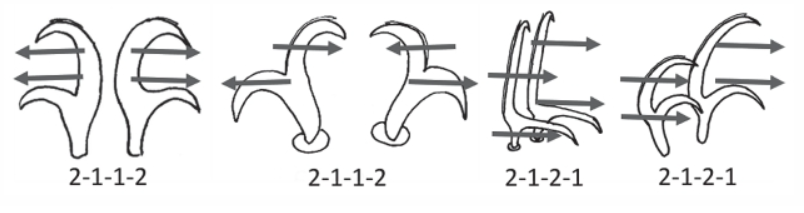
Claw Symmetry Relative To Median Plane Of Leg?

Image from Bingemer J, Hohberg K. 2017. An illustrated identification key to the eutardigrade species (Tardigrada, Eutardigrada) presently known from European soils. Soil Organisms. 89 (3): 127-149.

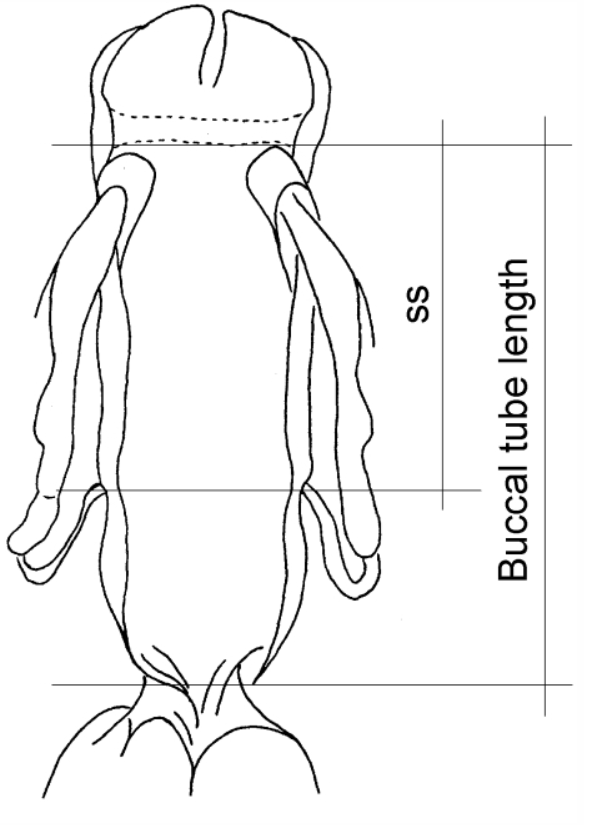
Stylet Support Insertion Point As Percentage Of Buccal Tube Length

Stylet support insertion point = ss divided by Buccal tube length, as %. Note anterior measurements begin at anterior margin of stylet sheaths, ss is centred where stylet supports reach buccal tube (this requires a good dorsal or lateral view for proper measurement)


Image from Tumanov DV. 2006. Five new species of the genus Milnesium (Tardigrada, Eutardigrada, Milnesiidae). Zootaxa. 1122: 1-23.

Buccal Tube Long, Mouth At Anterior Of A Protrusible Snout

Images from Pilato G, Binda MG. 2010. Definition of families, subfamilies, genera, and subgenera of the Eutardigrada, and keys to their identification. Zootaxa. 2404: 1-54.

Pharyngeal Tube With Spiral Reinforcement

Images from Pilato G, Binda MG. 2010. Definition of families, subfamilies, genera, and subgenera of the Eutardigrada, and keys to their identification. Zootaxa. 2404: 1-54.

Peribuccal papillae?

Images from Pilato G, Binda MG. 2010. Definition of families, subfamilies, genera, and subgenera of the Eutardigrada, and keys to their identification. Zootaxa. 2404: 1-54.

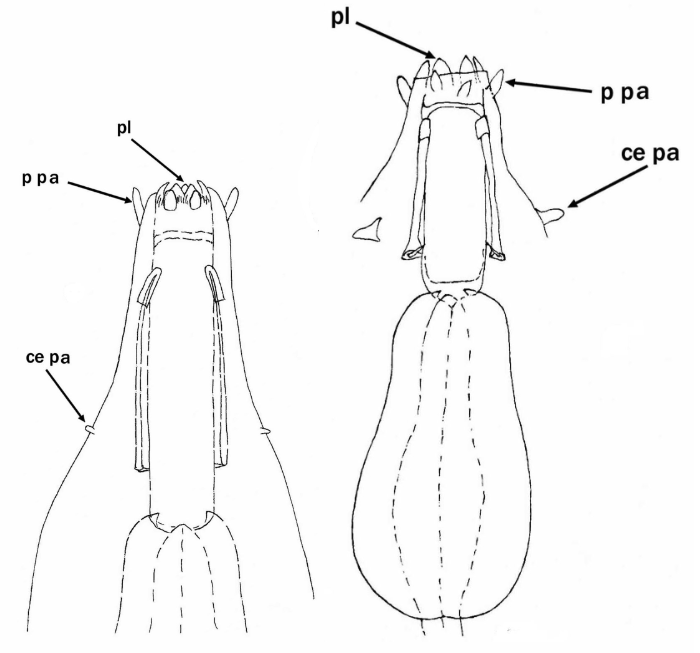
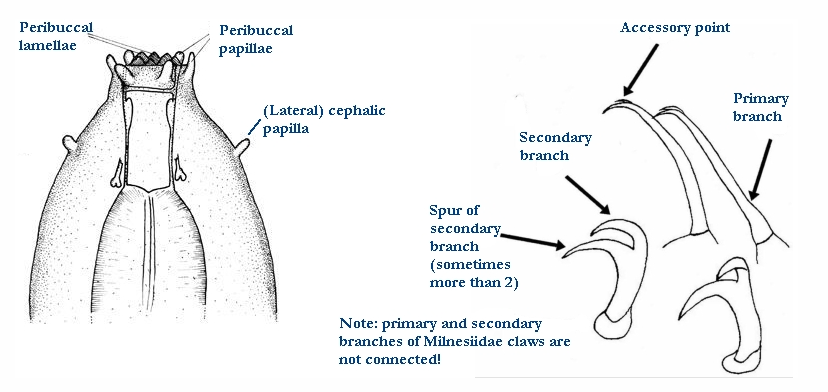
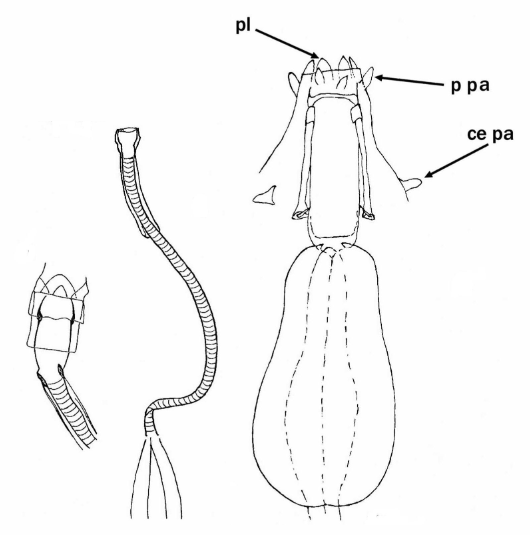
(Lateral) cephalic papillae, peribuccal papillae, Milnesiidae - type claws, exceptionally wide (and usually short) buccal tube?

Cephalic image modified from Nelson DR, Guidetti R, Rebecchi L. 2009. Tardigrada. Ch. 14 in Ecology and Classification of North American Freshwater Invertebrates, Thorp JH, Covich AP (eds.), 3rd ed.

Claw image modified from Pilato G, Binda MG. 2010. Definition of families, subfamilies, genera, and subgenera of the Eutardigrada, and keys to their identification. Zootaxa. 2404: 1-54.

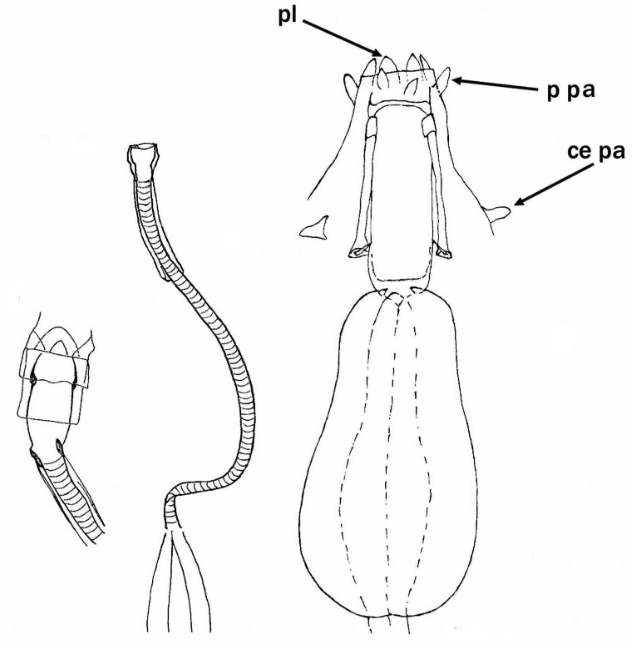
Pharyngeal tube flexible?

Note: in a tardigrade with snout extended, the flex of the pharyngeal tube may not be obvious.


Images from Pilato G, Binda MG. 2010. Definition of families, subfamilies, genera, and subgenera of the Eutardigrada, and keys to their identification. Zootaxa. 2404: 1-54.

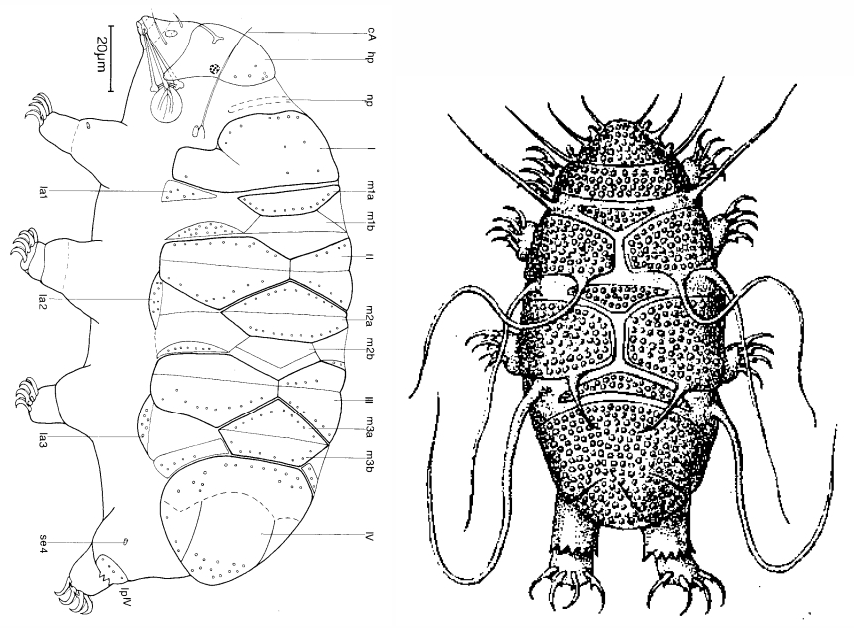
Serrated / dentate cuff / collar on legs IV

Left image from Kristensen RM. 1987. Generic revision of the Echiniscidae (Heterotardigrada), with a discussion of the origin of the family. pp. 261-335 in Bertolani R (ed). Biology of Tardigrades: Selected symposia and monographs.

Right Image from Richters F. 1926. Tardigrada. in Krumbach T. 1927. Handbuch der Zoologie, 3rd band, Walter de Gruyter & Co.

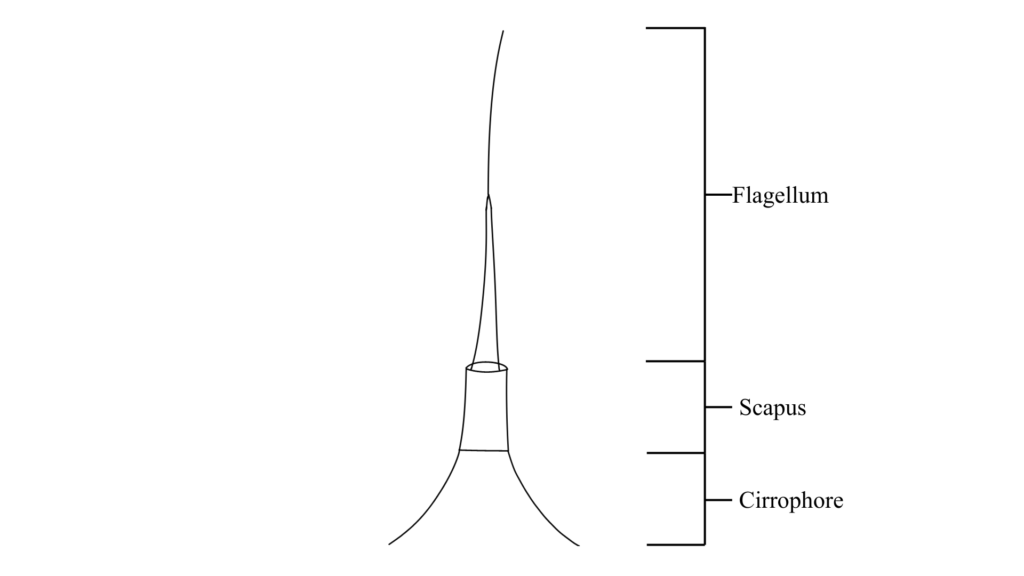
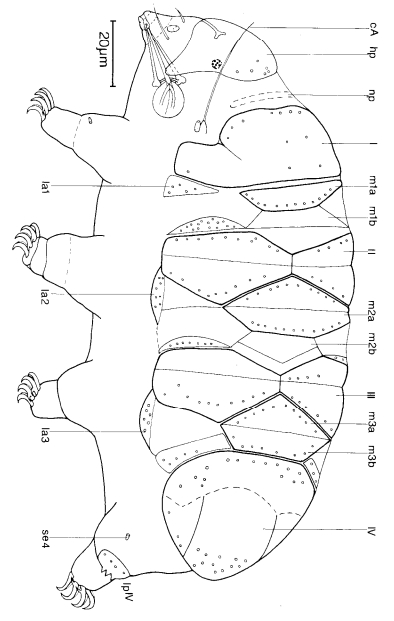
Leg sensory structures

Typically papilla on leg IV (se4 in image) and variable shape on leg I


Image from Kristensen RM. 1987. Generic revision of the Echiniscidae (Heterotardigrada), with a discussion of the origin of the family. pp. 261-335 in Bertolani R (ed). Biology of Tardigrades: Selected symposia and monographs.

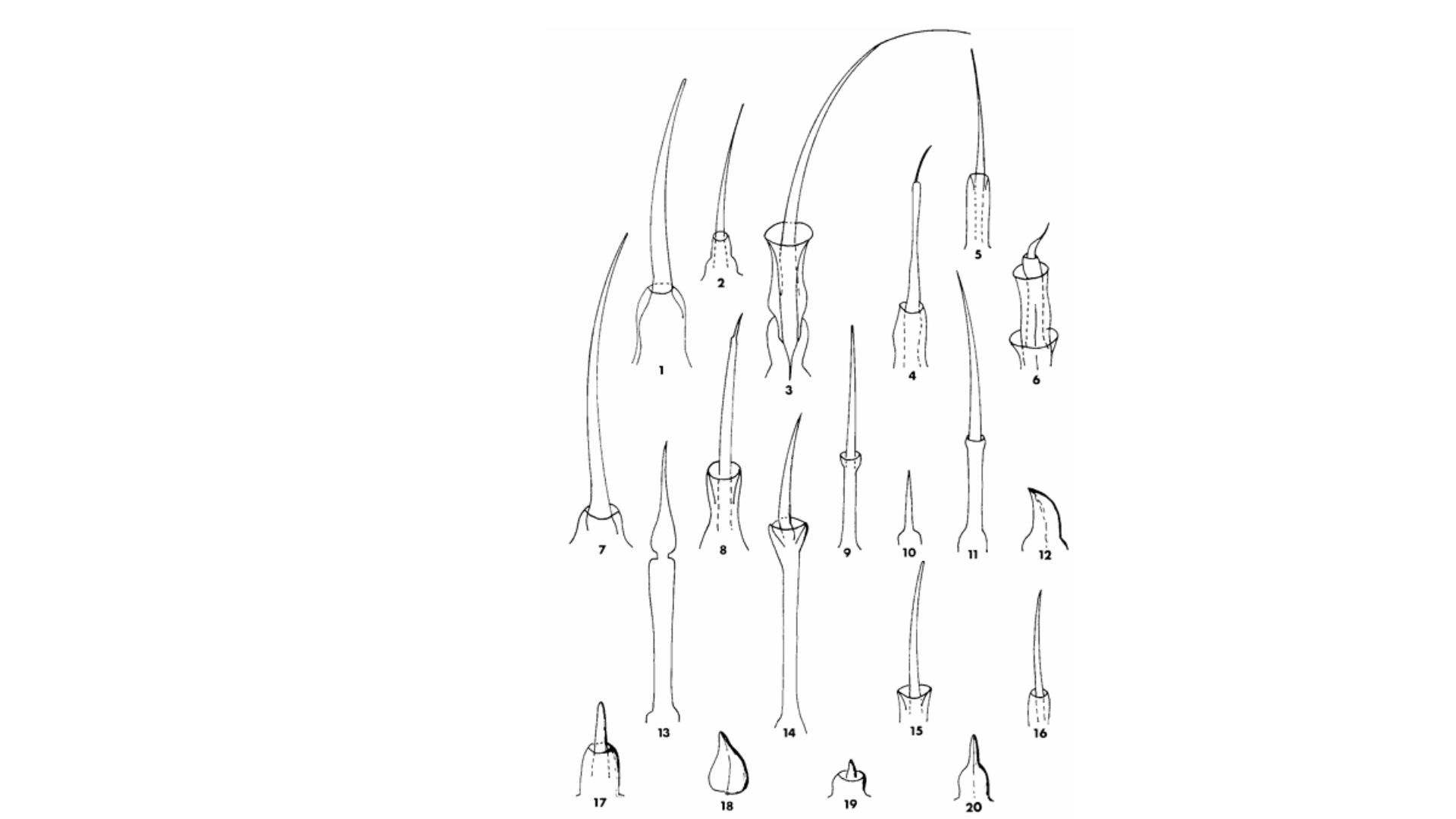
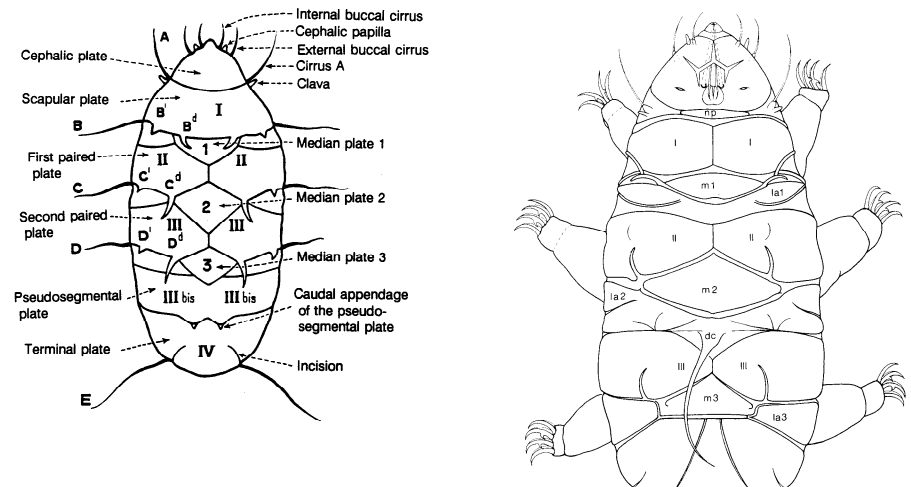
Trunk appendages

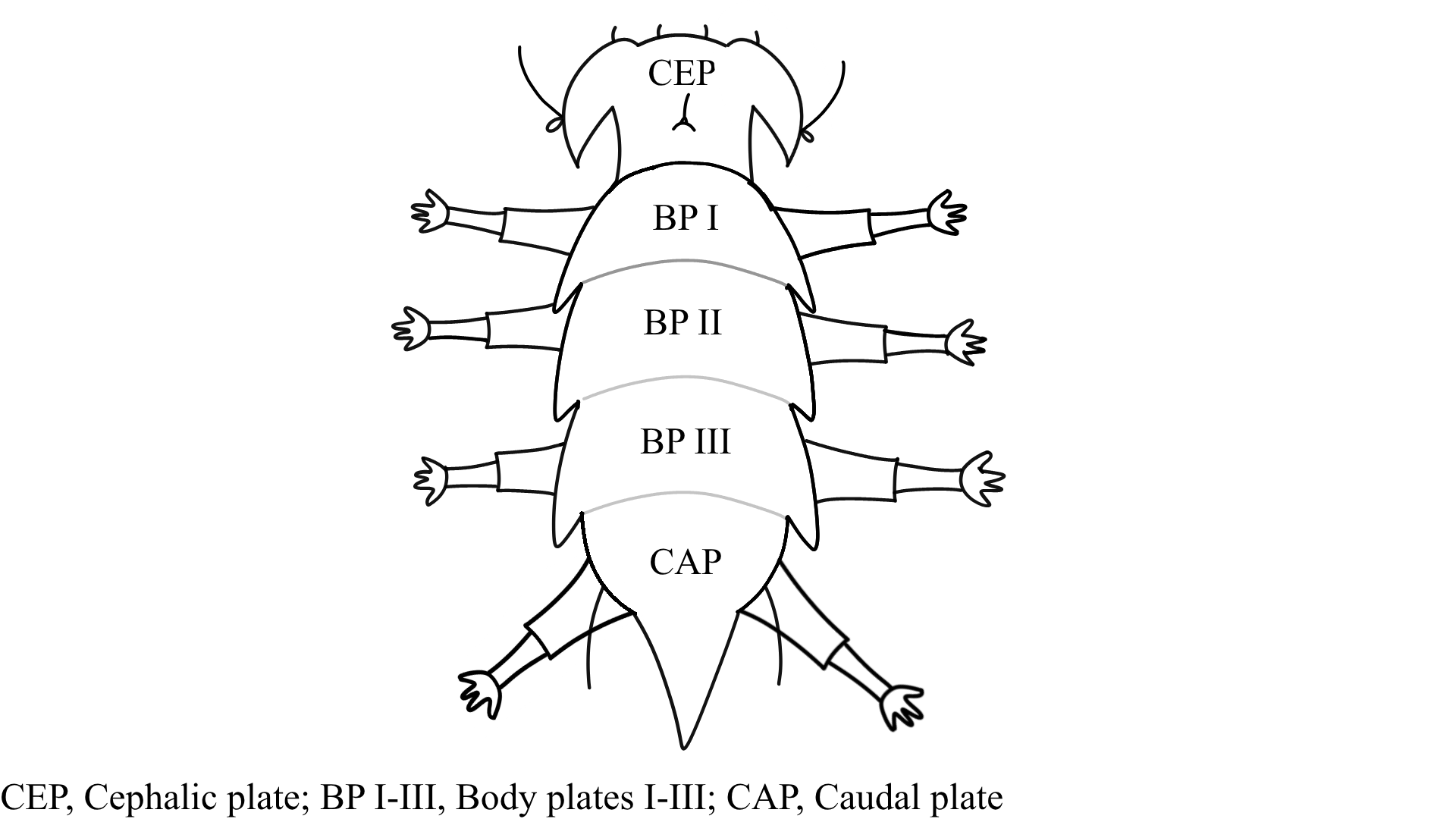
Appendages (after Cirrus A) labeled according to plate … B (Scapular plate), C (First segmental plate), D (Second segmental plate), E (terminal plate). “B” is lateral, “Bd” is dorsal

Be careful! There can be great variability within a population, with individuals (especially juveniles) lacking some appendages. When in doubt, focus on other characters first!


Left image from Ramazzotti G, Maucci W. 1983. Il phylum Tardigrada(III edizione riveduta e aggiornata). English translation by C. W. Beasley, 1995. Memorie dell’ Istituto Italiano di Idrobiologia 41: 1-1012.

Right image cropped from Kristensen RM. 1987. Generic revision of the Echiniscidae (Heterotardigrada), with a discussion of the origin of the family. pp. 261-335 in Bertolani R (ed). Biology of Tardigrades: Selected symposia and monographs.

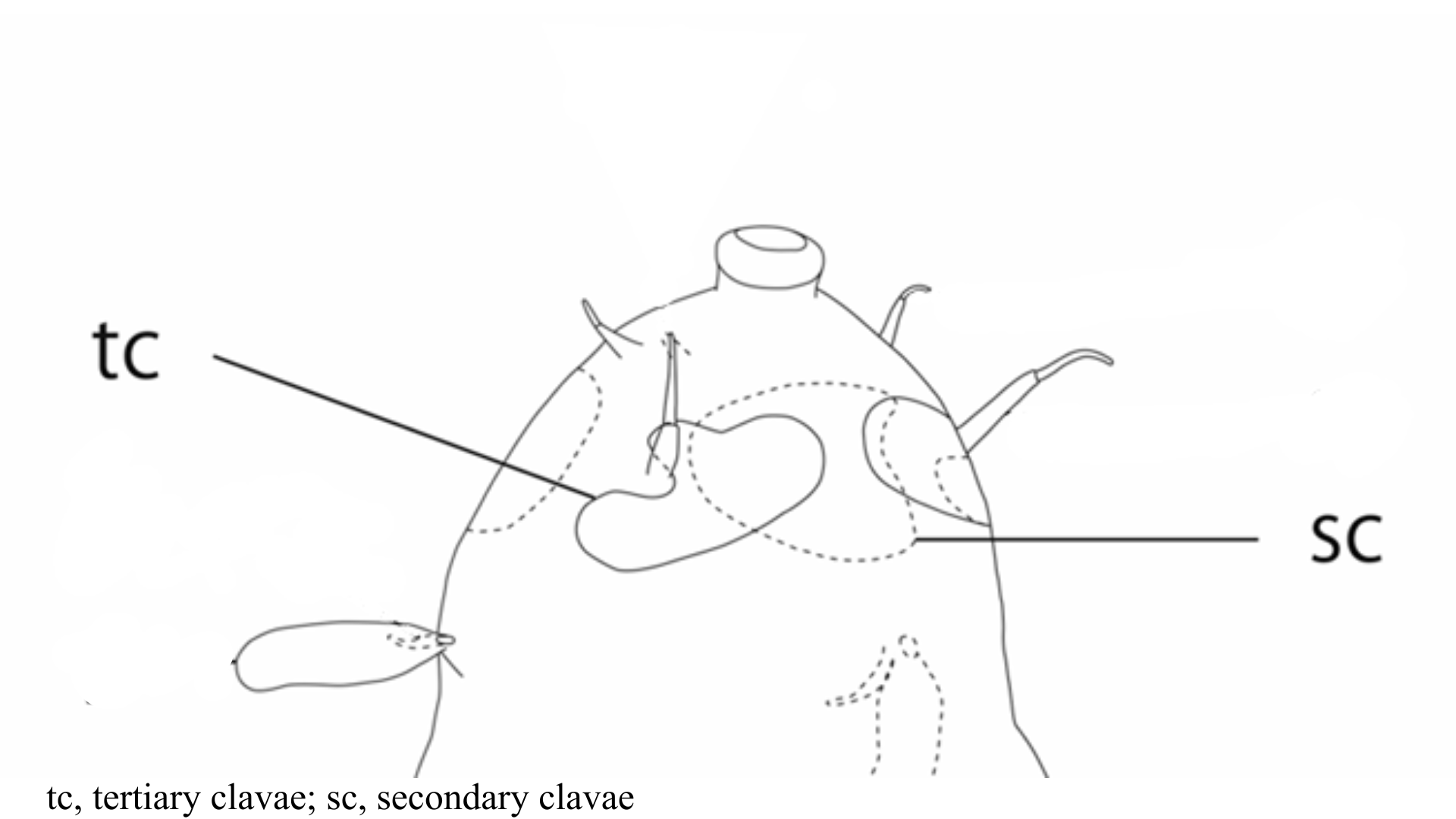
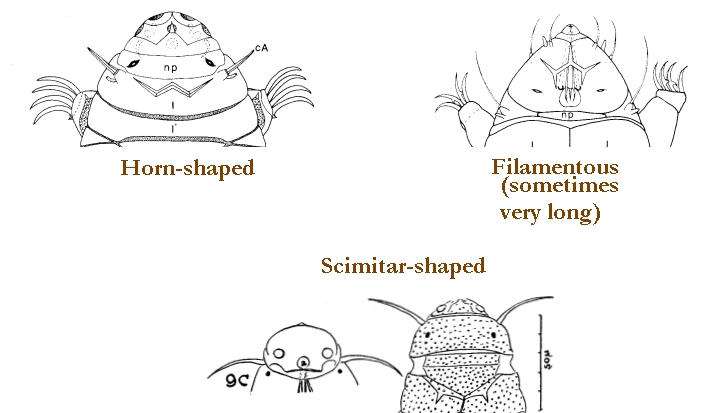
Cirrus A form

Images modified from Kristensen RM. 1987. Generic revision of the Echiniscidae (Heterotardigrada), with a discussion of the origin of the family. pp. 261-335 in Bertolani R (ed). Biology of Tardigrades: Selected symposia and monographs.

Lower image (Mopsechiniscus) modified from du Bois-Reymond Marcus E. 1944. Sobre tardigrados brasileiros. Communicaciones Zoologicas del Museo de Historia Natural de Montevideo. 1(13): 1-19 plus plates.

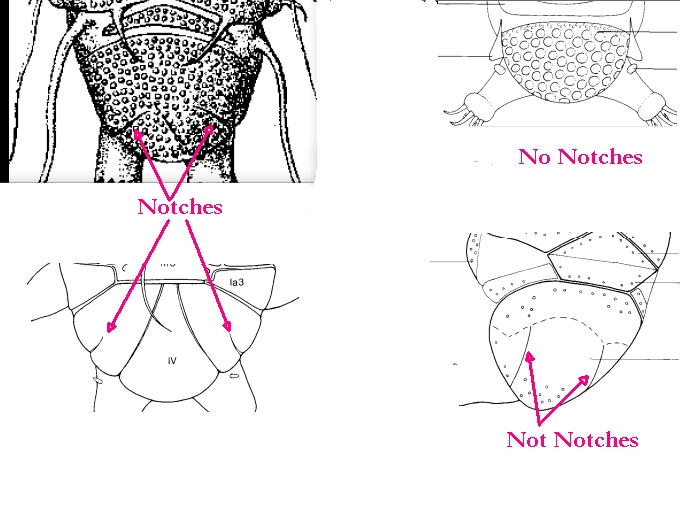
Terminal / caudal plate with two notches?

Images modified from Kristensen RM. 1987. Generic revision of the Echiniscidae (Heterotardigrada), with a discussion of the origin of the family. pp. 261-335 in Bertolani R (ed). Biology of Tardigrades: Selected symposia and monographs.

First image (Echiniscus) modified from Richters F. 1926. Tardigrada. in Krumbach T. 1927. Handbuch der Zoologie, 3rd band, Walter de Gruyter & Co.

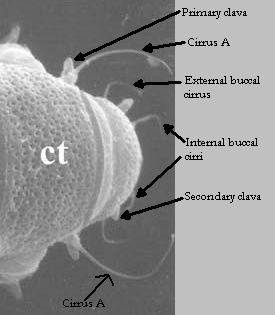
Inner & outer buccal cirri present

Image modified from Nelson DR, Guidetti R, Rebecchi L. 2009. Tardigrada. Ch. 14 in Ecology and Classification of North American Freshwater Invertebrates, Thorp JH, Covich AP (eds.), 3rd ed.

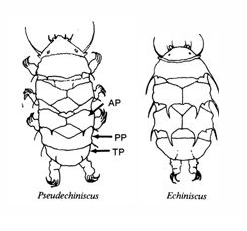
Pseudosegmental plate between last medial plate & terminal plate?

Note on 2nd image, what you see before the terminal plate is either no plate, or a full-width medial plate; don’t confuse the latter with a pseudosegmental plate!
Also, sometimes the pseudosegmental plate is paired, like segmental plates II & III. It’s still pseudosegmental!

Images from Clifford HF. 1991. Aquatic invertebrates of Alberta. University of Alberta Press, Alberta, Canada.

Segmental plates larger than intersegmental?

Image modified from Lindahl & Balser (1999), http://www.iwu.edu/~tardisdp/Keypage35.html

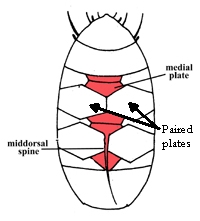
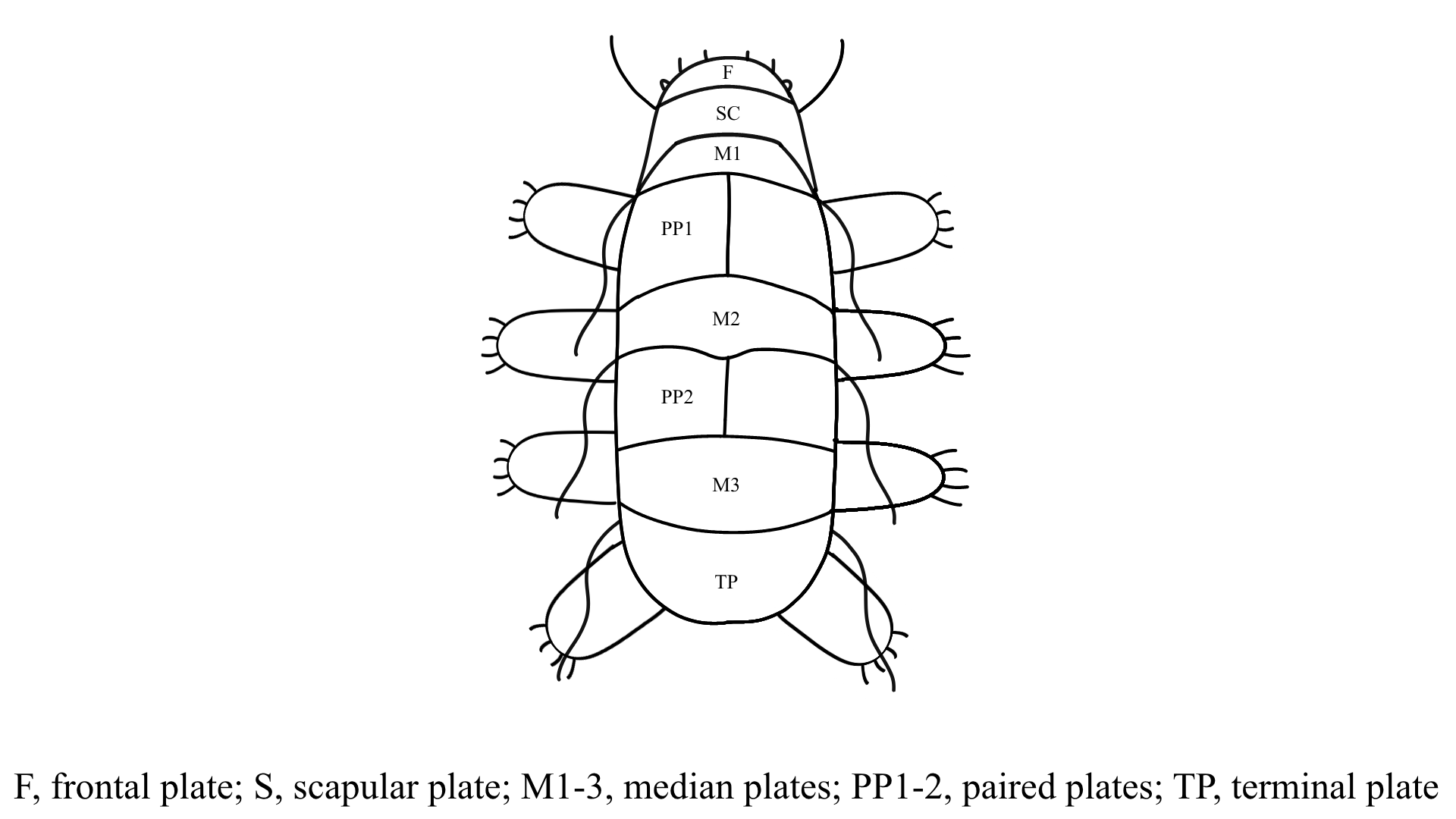
Any Paired Plates?

Modified from Lindahl K, Balser S.  1999. Key to tardigrade genera [Internet]. Available from: https://sun.iwu.edu/~tardisdp/Keypage33.html