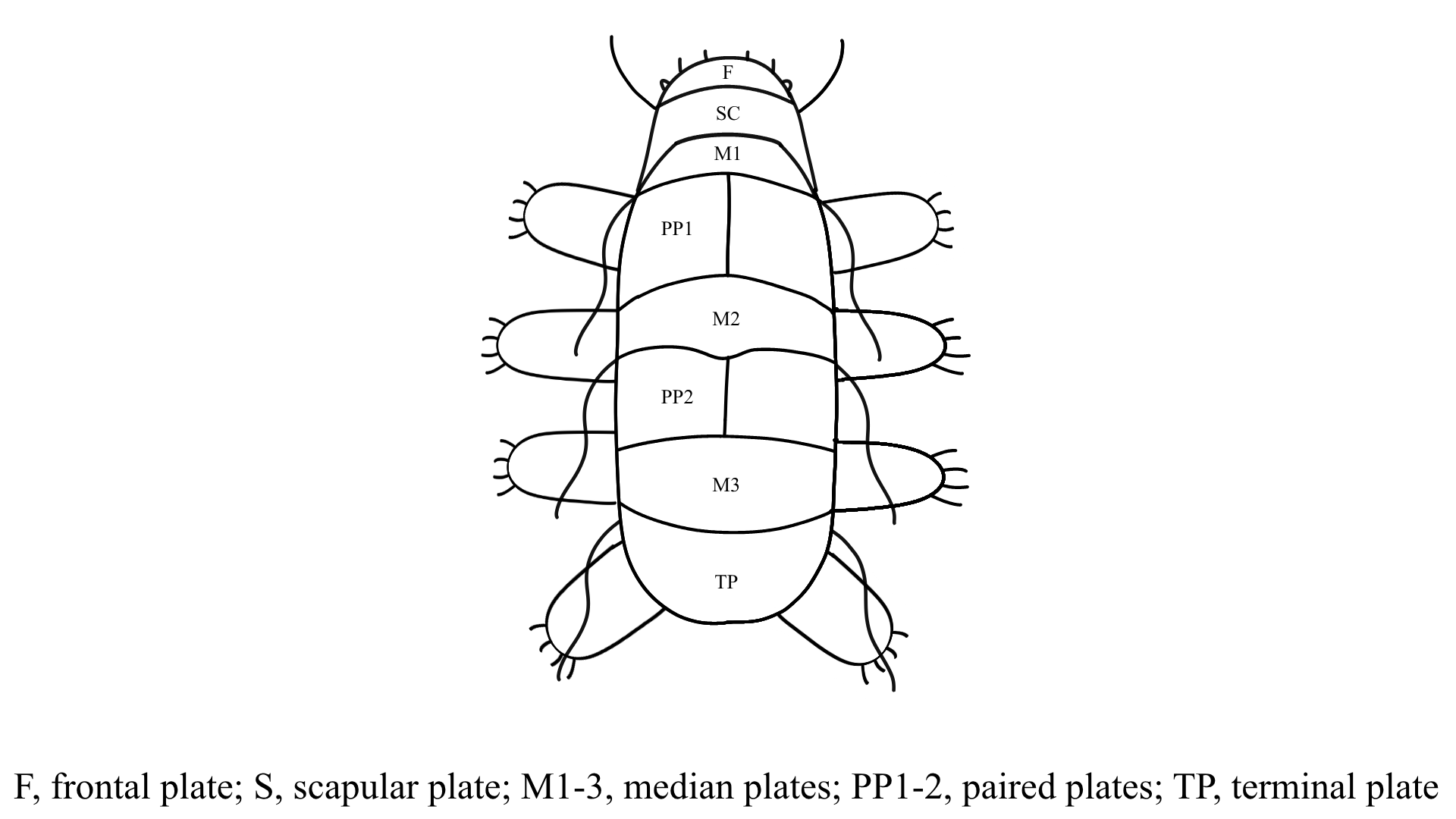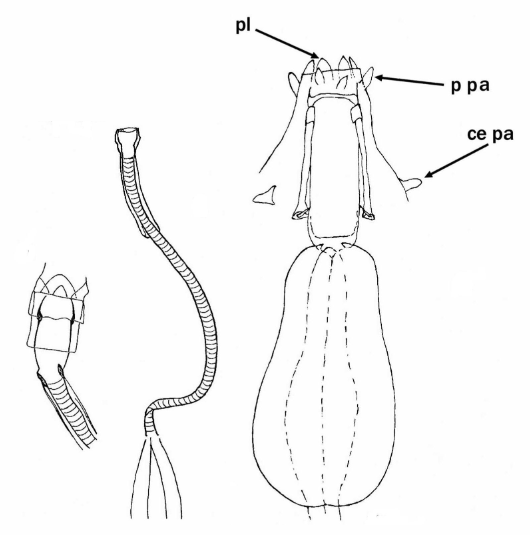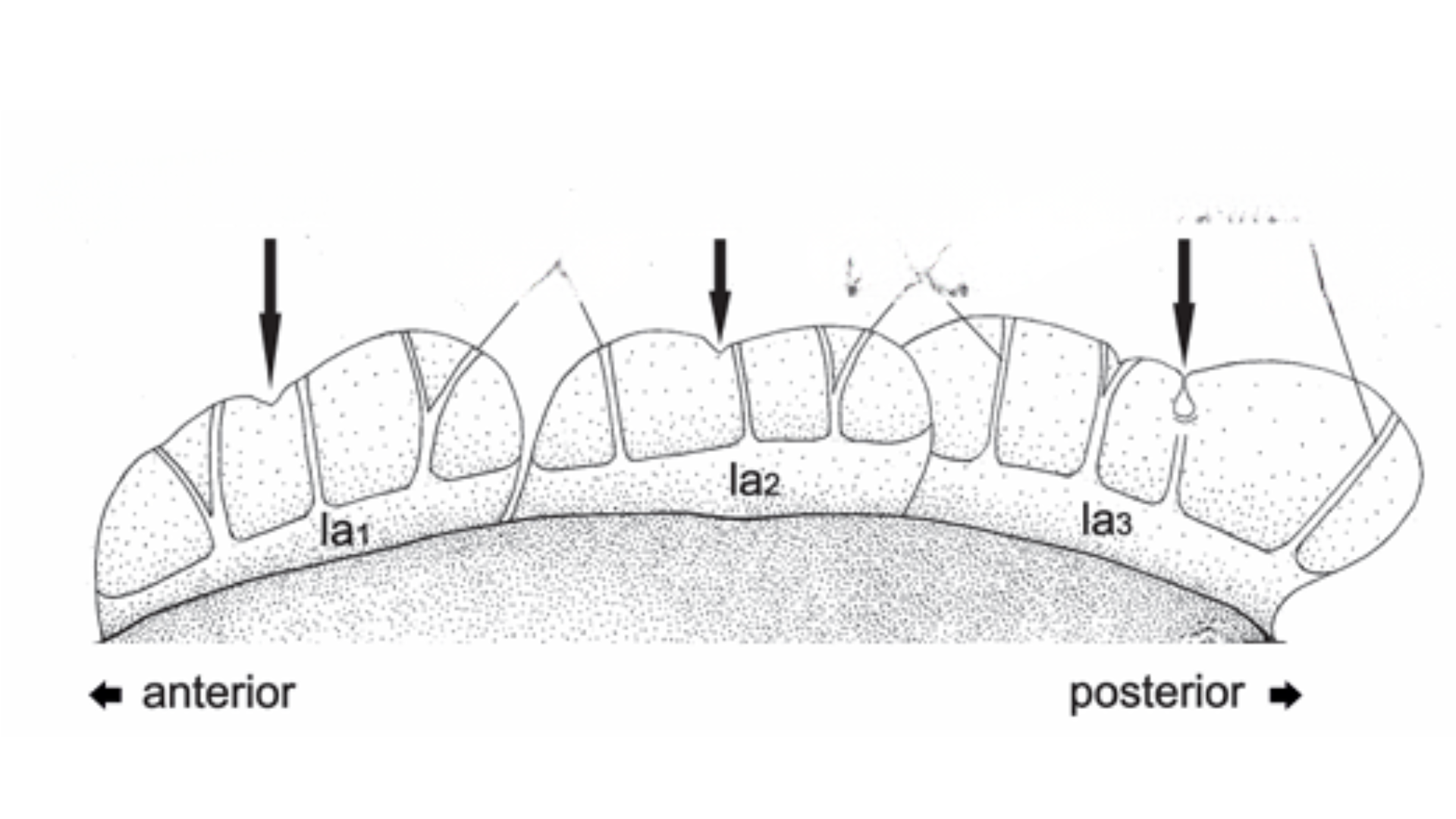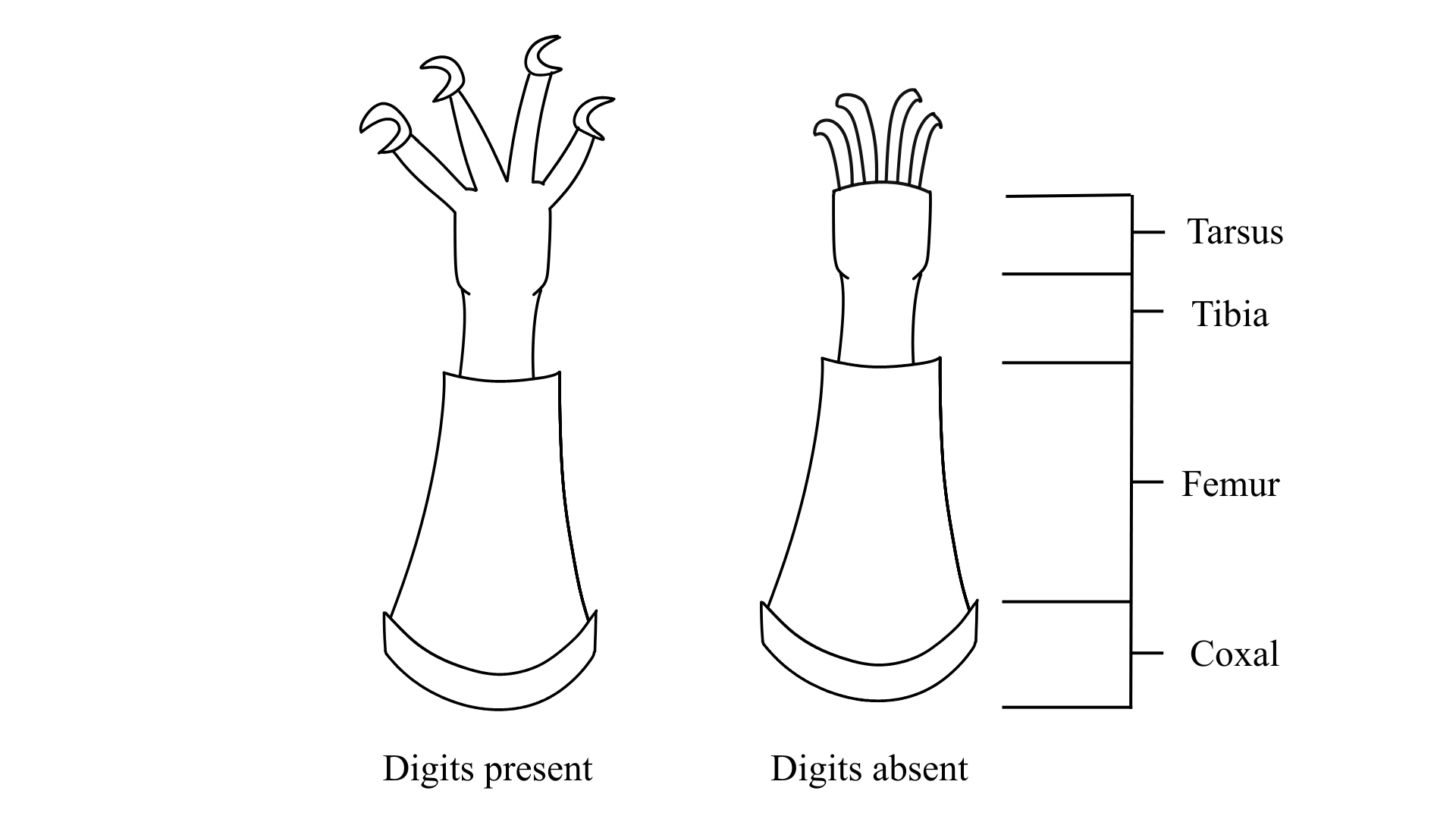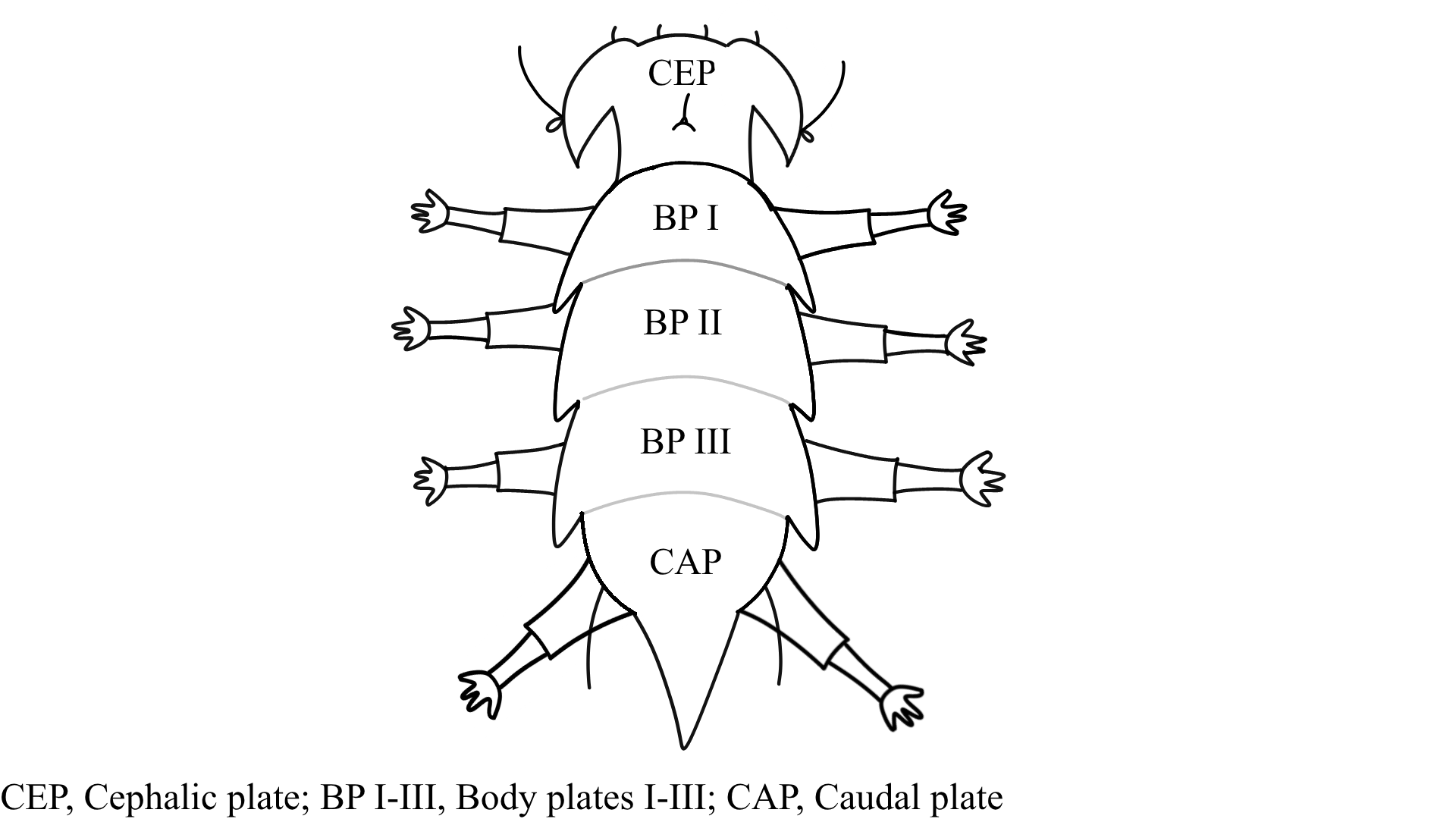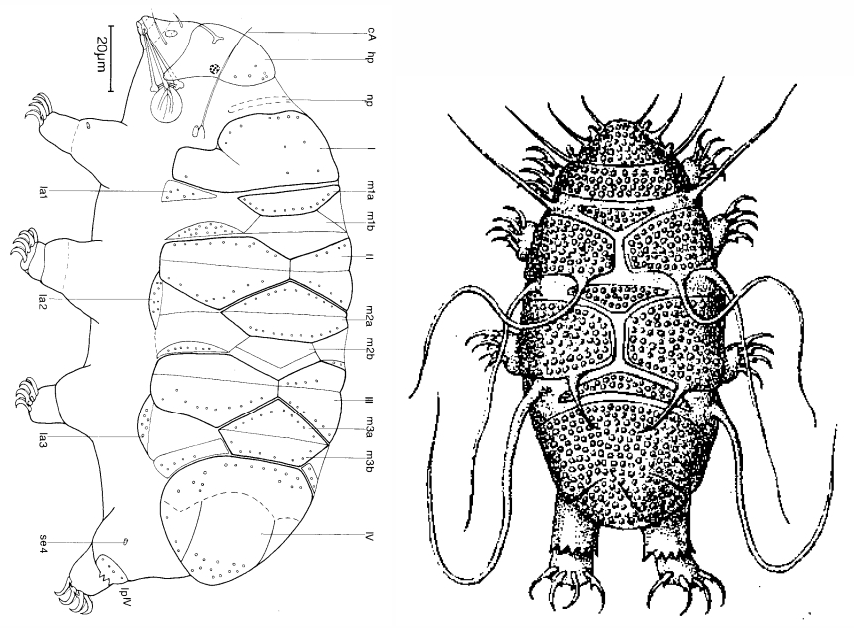

Genus description from Cooper, 1964: “Mouth without discernible palps or other appendages, dorsally and laterally enclosed by a well-defined cuticular frontal element which caps and delineates the “head” ; no cephalic appendages, no lateral cirrus, no clava, and no discernible eye-spots. Body naked; cuticle evidently regionally thickened dorsally, annulated by transverse lines of flexion, but not sclerotized into distinct exoskeletal plaques either dorsally or ventrally. Legs moderately long, telescopable; each leg with four claws (or 2 two-branched claws ?), and with a short, anterior, flattened, apical cuticular extension or spine, but without lateral or basal papillae.”
Genus description abridged from Mapalo et al. 2004 (based on only extant specimen): “Length of at least 309 μm since it is
slightly bent at the section between the third and fourth pairs of legs. The cuticle appears to be smooth with no visible cuticular extensions, but cuticular folds are expressed on the dorsal side, potentially produced during preservation. Eyespots were not observed. The legs are lobopodous but feature transverse cuticular folds likely produced by cuticle shrinkage during preservation, and it is not telescopic as indicated in its original description. The external and internal claws
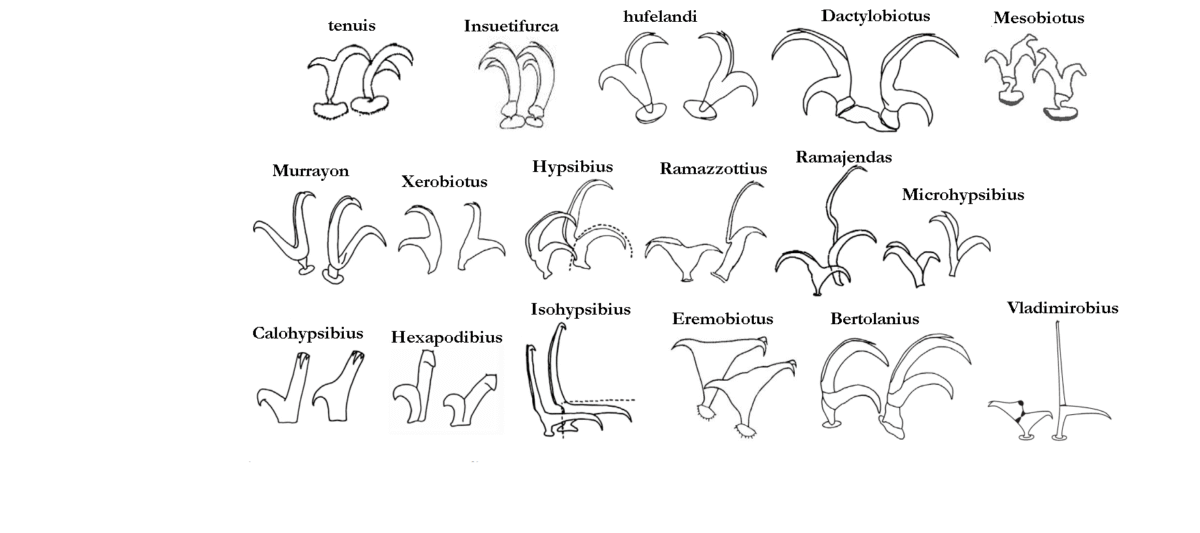
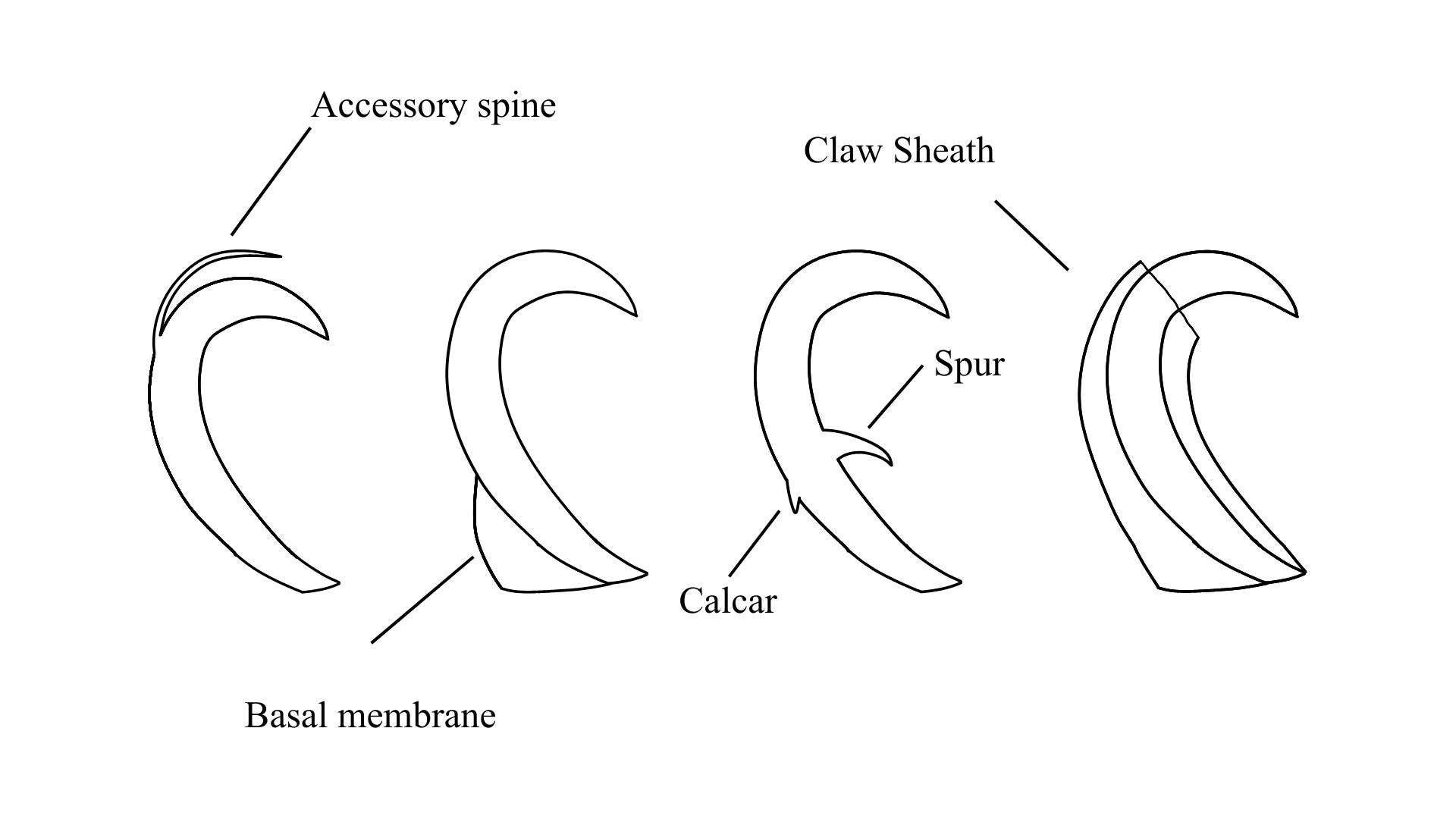
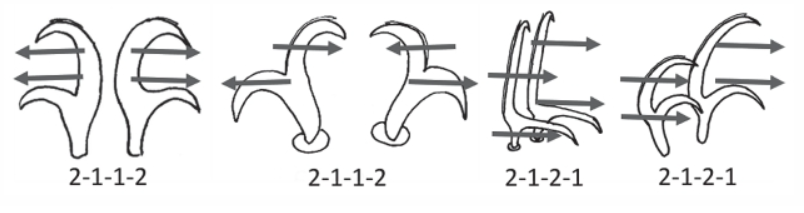
(posterior and anterior claws in the fourth leg) differ greatly in shape and size. The external and posterior claws feature a secondary branch forming a continuous curve with its basal tract and the primary branch connected with an evident flexible part while the internal and anterior claws are more robust and rigid. These features correspond to Hypsibius-type claws as expressed in members of the family Hypsibiidae. The external and posterior claws have primary branches that are clearly longer than the secondary branches. Pseudolunules were not observed, while accessory points are observed on the posterior
claws.”


Citations:
Cooper, K.W. (1964) The first fossil tardigrade: Beorn leggi Cooper, from cretaceous amber. Psyche, 71(2), 41-48.
Mapalo MA, Wolfe JM, Ortega-Hernánd J. 2024. Cretaceous amber inclusions illuminate the evolutionary origin of tardigrades. Communications Biology. 7: 953. https://doi.org/10.1038/s42003-024-06643-2