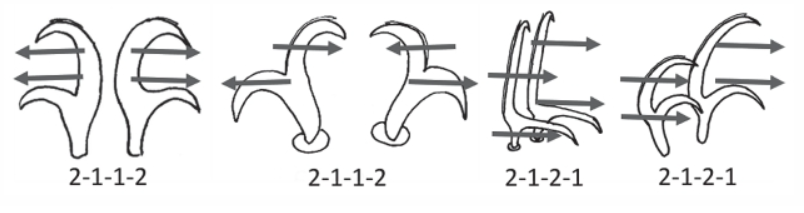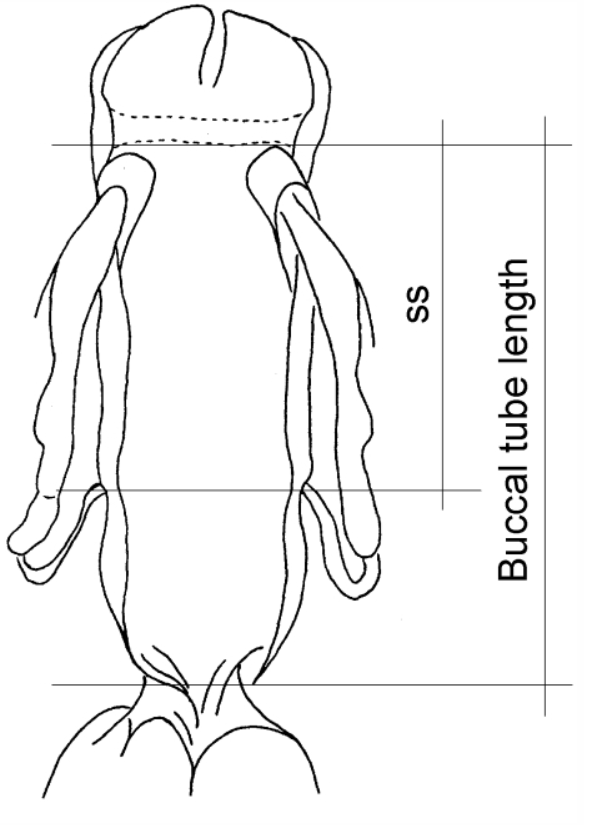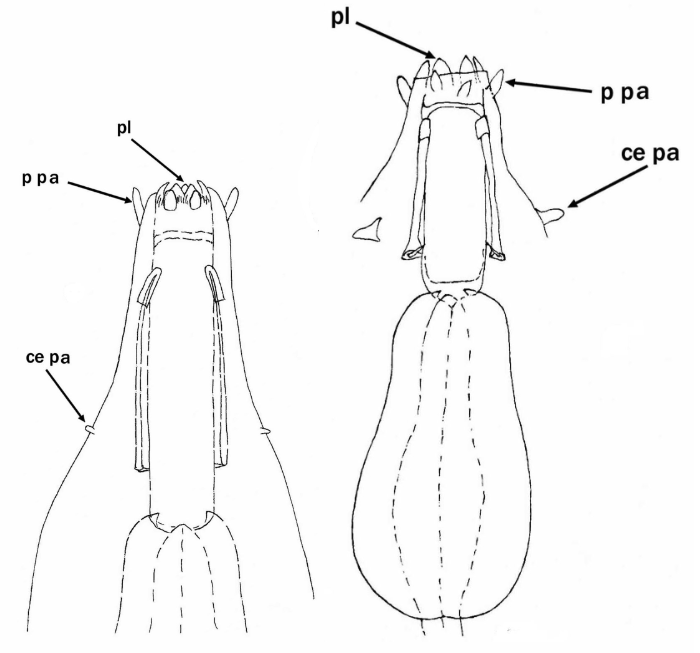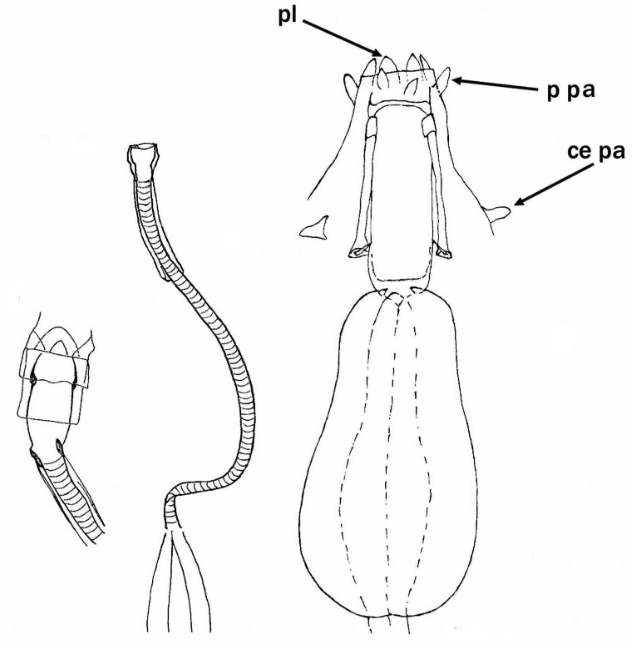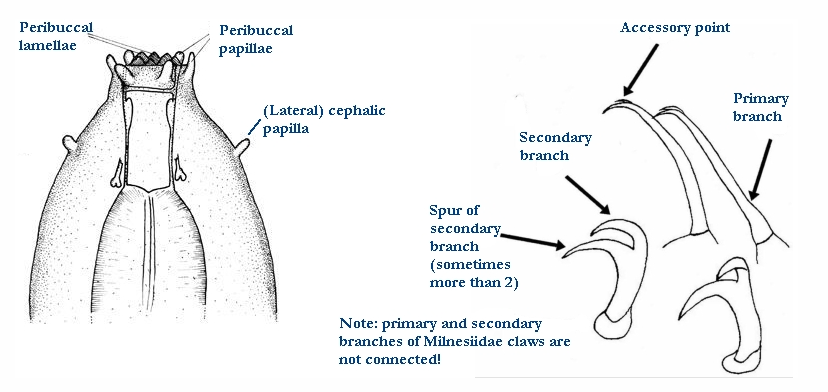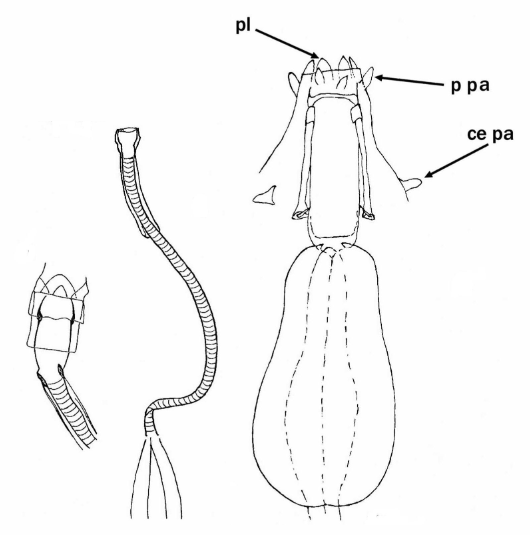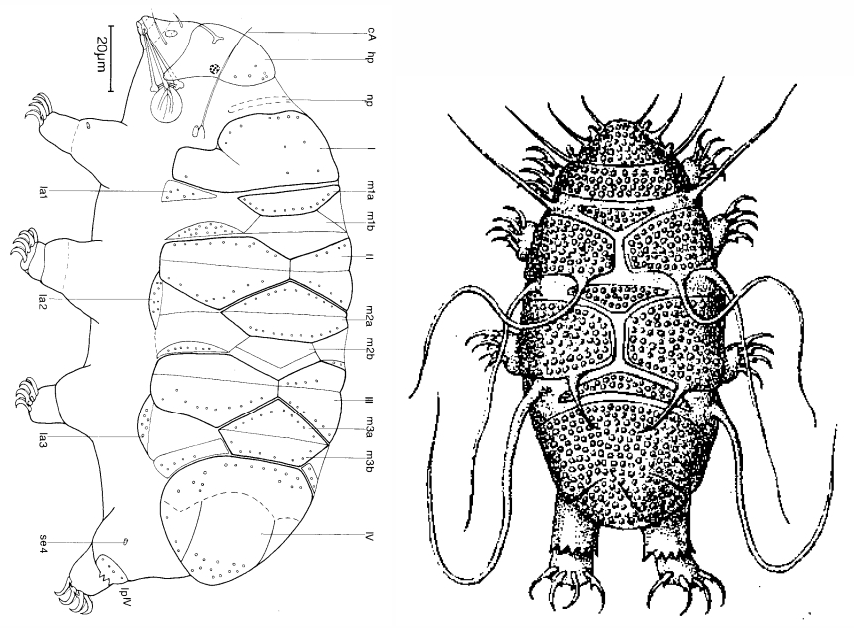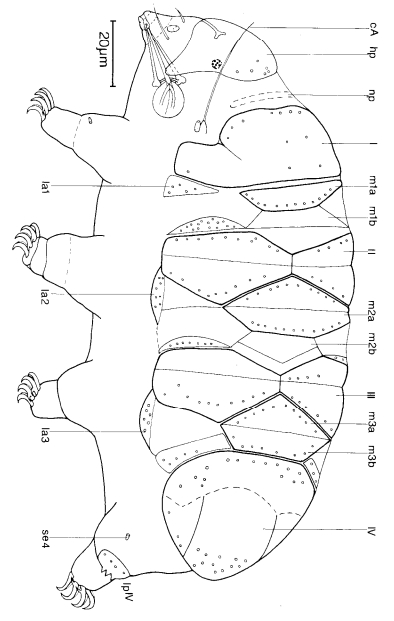

Genus description abridged from Mapalo et al. 2004 (based on only extant specimen): “Body length is ~100 μm. The cuticle appears to be smooth with no observable protuberances. Cuticular folds are observed on the dorsal side, mostly likely due to its preservation in a shriveled state. Eyespots were not observed. A faint oval-shaped outline can be observed on the dorso-lateral side of the head region. Its distinct outline compared to other parts of the body is more evident in inverted greyscale images. The mouth opening can be observed and appears to be smooth and devoid of peribuccal structures (e.g., peribuccal lamellae and peribuccal papulae, On the first to third legs, the external and internal claws have slightly similar sizes, but their shape differs greatly. The external claws have a modified Isohypsibius-type configuration (most evident in claw II) wherein the secondary branch and basal section form a right angle, but the primary branch is connected to the basal section with an evident flexible part, characterized by a curved base of the primary branch, similar to what is observed in Beorn leggi and other extant tardigrades with Hypsibius-type and Ramazzottius-type claws. In contrast, the fourth leg pair
possess posterior and anterior claws that are greatly different in shape and size. The fourth leg posterior claws appear to be either typical Hypsibius-type claws wherein the secondary branch forms a continuous curve with the basal section or modified Isohypsibius-type claws similar to the first three legs. Unfortunately, the orientation of the claws does not allow us to confidently discern between these two character options. An evident flexible connection between the primary branch and basal section is present. Furthermore, the primary branch of the posterior claw in the fourth leg is notably longer than its associated secondary branch. These differences between the two branches are not obvious in the external claws of the first to third legs. The internal and anterior claws appear to be robust and rigid. Pseudolunules are at least observed in the internal
claws, while accessory points are observed in the external and posterior claws.

Citations:
Mapalo MA, Wolfe JM, Ortega-Hernánd J. 2024. Cretaceous amber inclusions illuminate the evolutionary origin of tardigrades. Communications Biology. 7: 953. https://doi.org/10.1038/s42003-024-06643-2