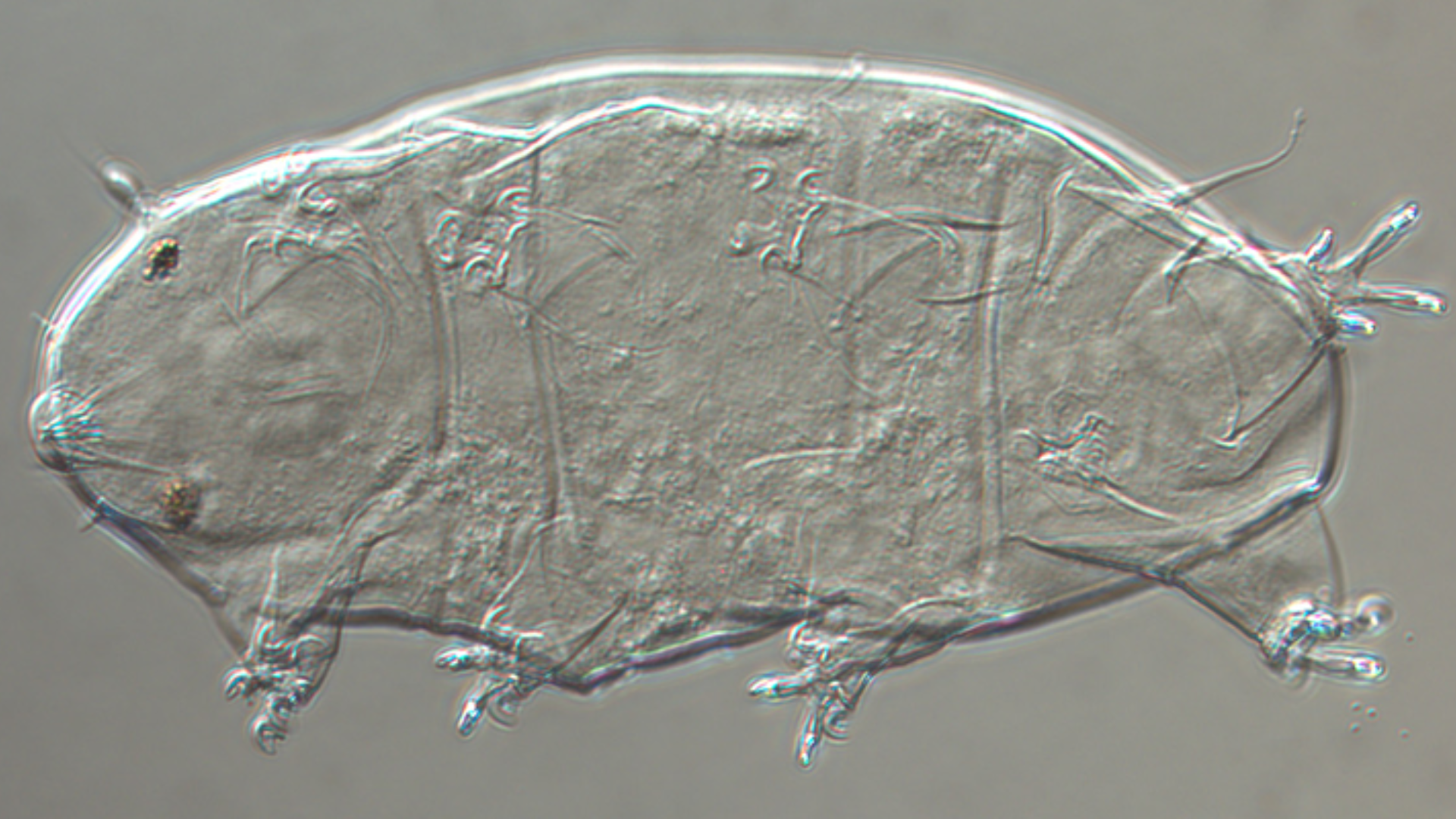
Archechiniscus

Click taxa for descriptions

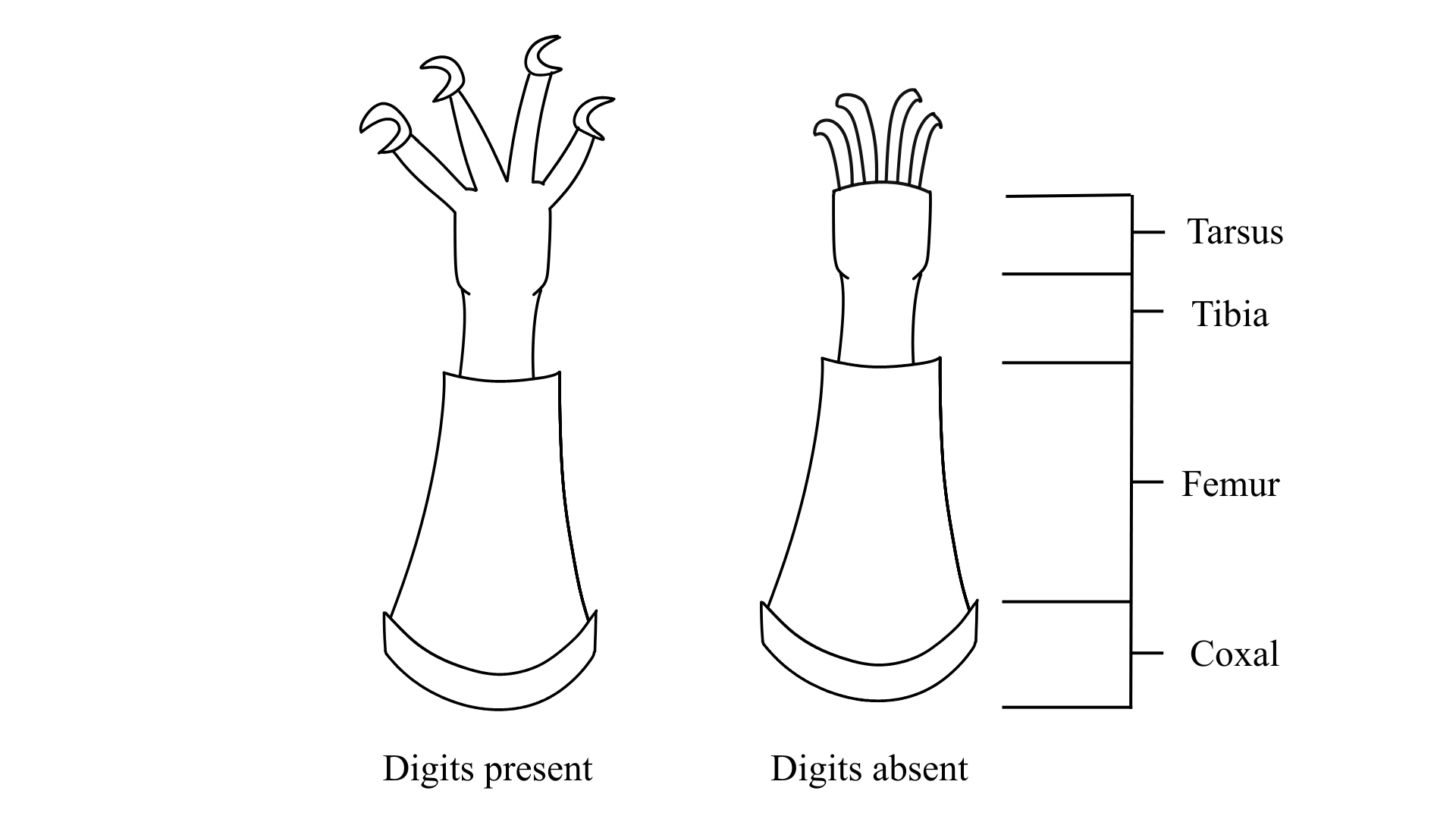
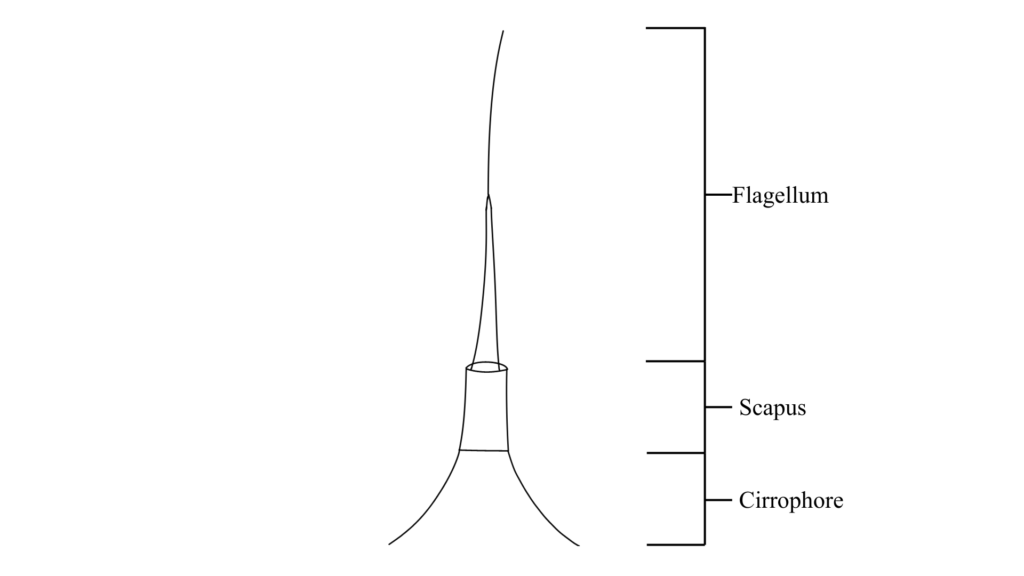
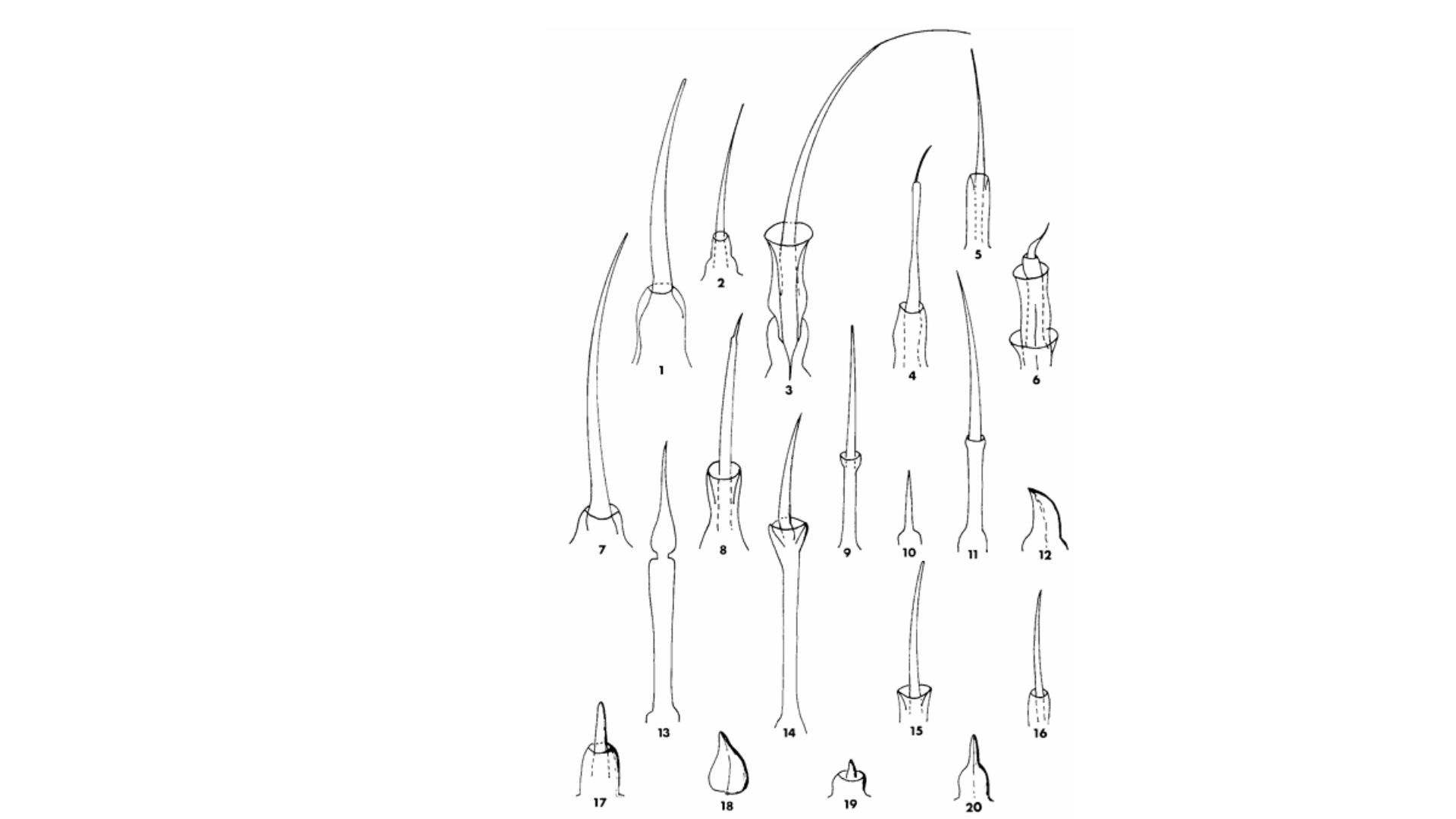
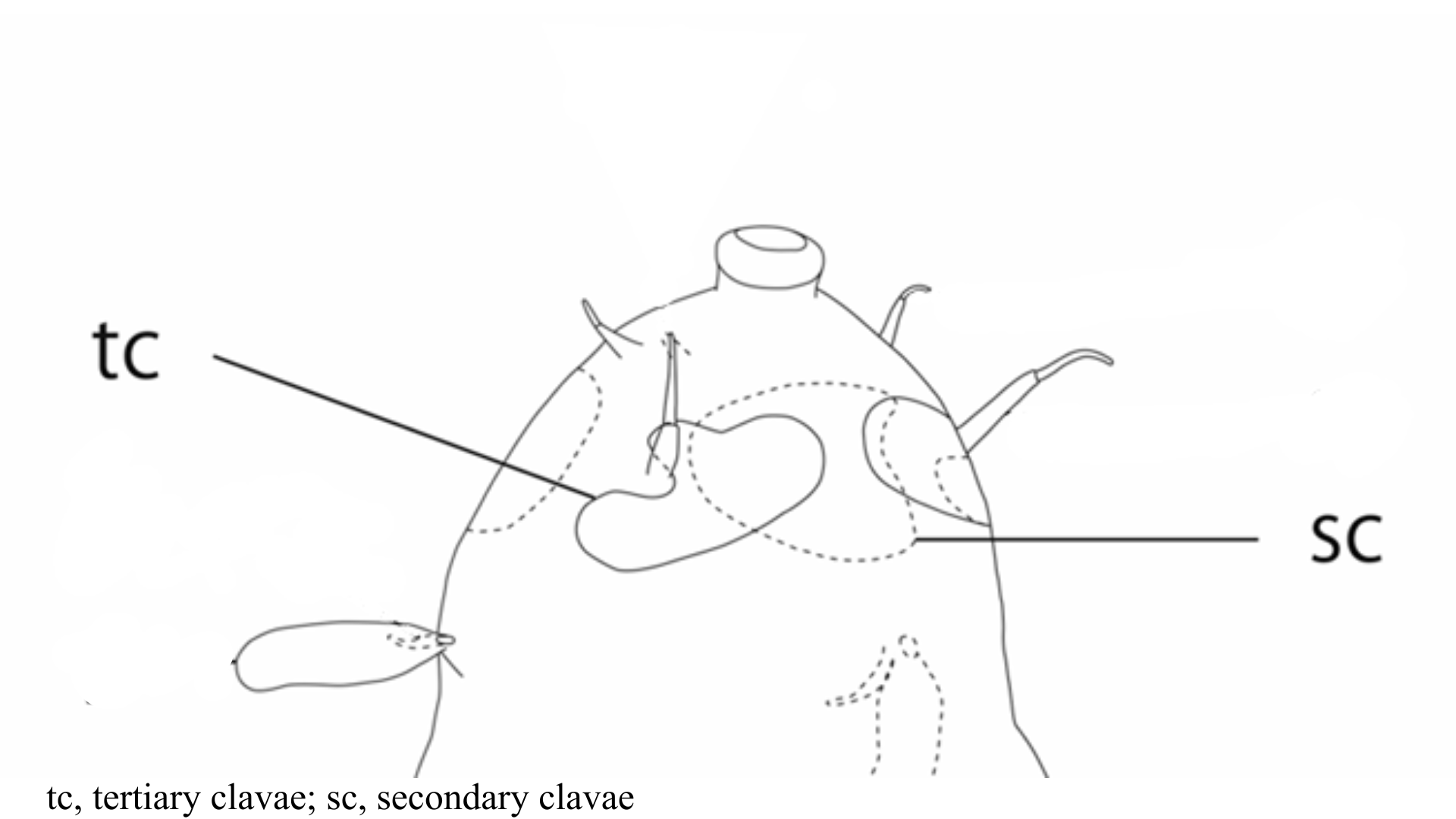
Genus description from Schulz 1953: “Archech. ist ein Echiniscoid mit fehlendem Cirrus medianus; alle übrigen Kopfanhänge sind kurz, die Oralparie ist vorgezogen. Die Extremitäten tragen vier Krallen, von denen jeweils die Außenkrallen basale Nebenhaken besitzen, ganz so wie die meisten Echiniscus-Innenkrallen, und die dem Extremitätenstamm, mit dem sie dorsal durch die Zwischenkrallenhaut verbunden sind, unmittelbar aufsizten. Die beiden mittleren Krallen aber sitzen an Zehen, die distal wie bei Halechiniscus etwas angeschwollen sind, und zwar ebenfalls unterständig. Die ventrale Strecke dieser Zehen zwischen dem Extremitätenstamm und dem Beginn der Krallen scheint ähnlich versteift zu sein, wenn auch weniger deutlich, wie bei Styraconyx sargassi Thulin, wo dieser Schaft an der Kralle der Gattung den Namen gegeben hat. Wir sehen hier also den bisher einzigartigen Fall von Zehenbildung innerhalb der Echiniscoidea, ferner den ungewöhnlichen, daß bei einem Echiniscoid die Außenkrallen basale Nebenhaken tragen, während bislang nur in wenigen Fällen gerade Basaldorne bekannt waren.”

Translated: Archechiniscus is an echiniscoid with a missing median cirrus; all other head appendages are short, and the mouth is protruding. The legs bear four claws, of which the outer claws each have basal secondary hooks, just like most Echiniscus inner claws, and which are attached directly to the limb stem, to which they are connected dorsally by the interclaw membrane. The two middle claws, however, are attached to toes that are somewhat swollen distally, as in Halechiniscus, and are also smaller. The ventral section of these toes between the limb stem and the beginning of the claws appears to be similarly stiffened, although less clearly, as in Styraconyx sargassi Thulin, where this shaft on the claw gave the genus its name. Here we see the hitherto unique case of toe formation within the Echiniscoidea, and furthermore the unusual fact that in an Echiniscoid the outer claws carry basal side hooks, whereas up to now basal spines were only known in a few cases.

Species key in: Bartels PJ, Fontoura P, Nelson DR. 2018. Marine tardigrades of the Bahamas with the description of two new species and updated keys to the species of Anisonyches and ArchechiniscusZootaxa4420(1): 43-70.


Citations:

Schulz, E. (1953) Orzeliscus septentrionalis nov. spec., ein neuer mariner Tardigrad an der deutschen Nordseeküste. Kieler Meeresforschungen, 9, 288-292.
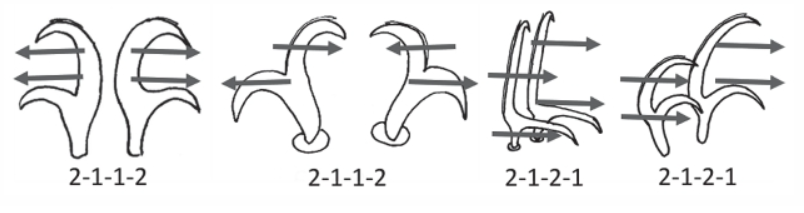
Claw Symmetry Relative To Median Plane Of Leg?

Image from Bingemer J, Hohberg K. 2017. An illustrated identification key to the eutardigrade species (Tardigrada, Eutardigrada) presently known from European soils. Soil Organisms. 89 (3): 127-149.

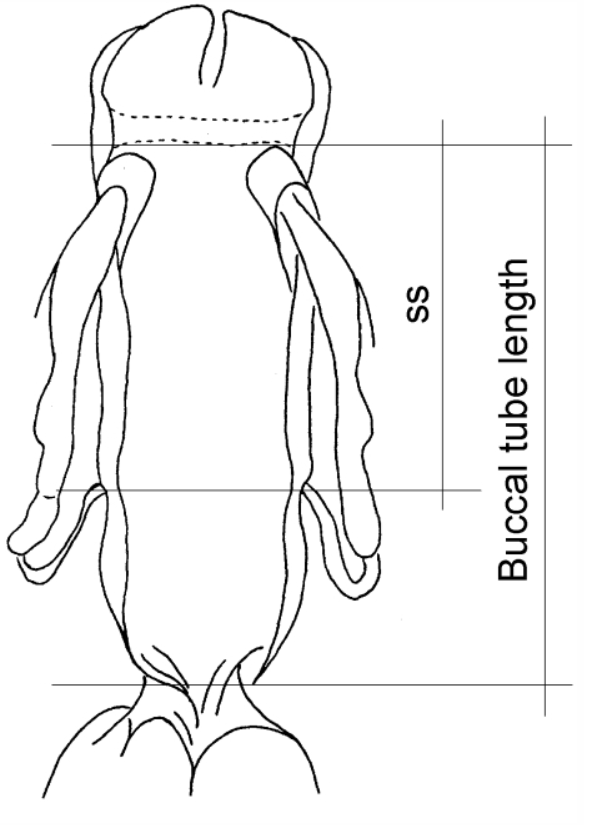
Stylet Support Insertion Point As Percentage Of Buccal Tube Length

Stylet support insertion point = ss divided by Buccal tube length, as %. Note anterior measurements begin at anterior margin of stylet sheaths, ss is centred where stylet supports reach buccal tube (this requires a good dorsal or lateral view for proper measurement)


Image from Tumanov DV. 2006. Five new species of the genus Milnesium (Tardigrada, Eutardigrada, Milnesiidae). Zootaxa. 1122: 1-23.

Buccal Tube Long, Mouth At Anterior Of A Protrusible Snout

Images from Pilato G, Binda MG. 2010. Definition of families, subfamilies, genera, and subgenera of the Eutardigrada, and keys to their identification. Zootaxa. 2404: 1-54.

Pharyngeal Tube With Spiral Reinforcement

Images from Pilato G, Binda MG. 2010. Definition of families, subfamilies, genera, and subgenera of the Eutardigrada, and keys to their identification. Zootaxa. 2404: 1-54.

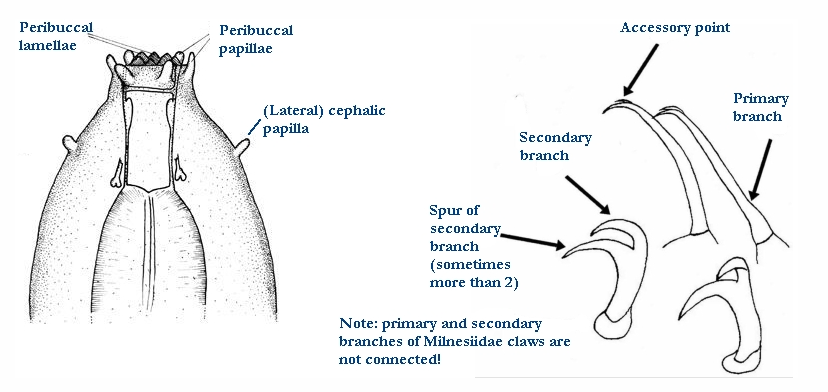
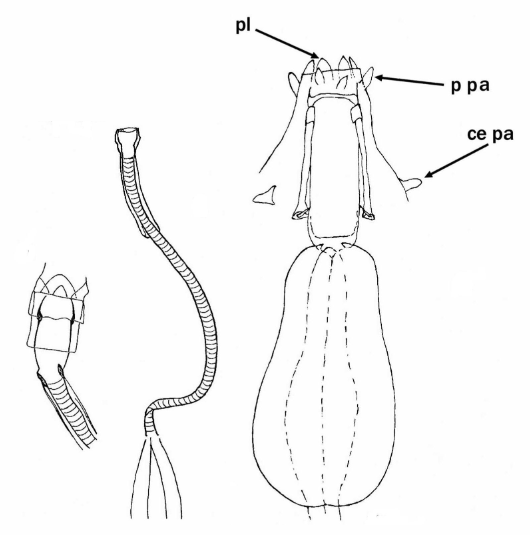
Peribuccal papillae?

Images from Pilato G, Binda MG. 2010. Definition of families, subfamilies, genera, and subgenera of the Eutardigrada, and keys to their identification. Zootaxa. 2404: 1-54.

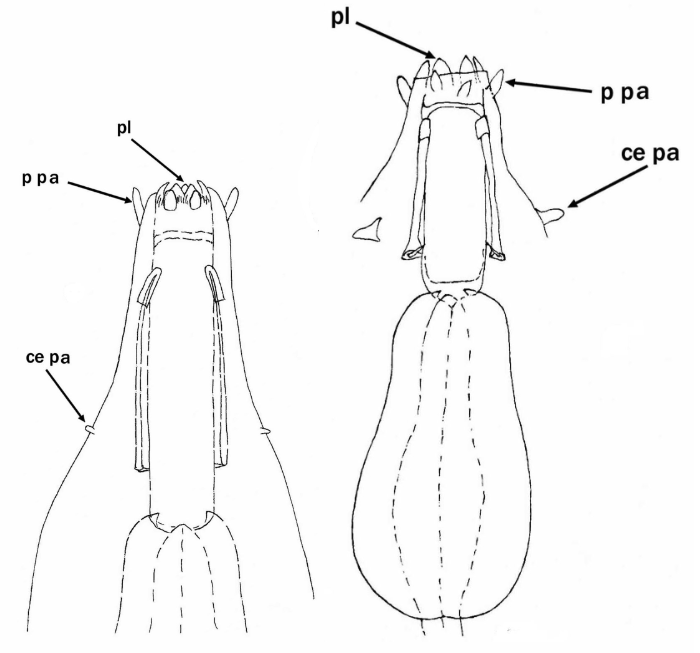
(Lateral) cephalic papillae, peribuccal papillae, Milnesiidae - type claws, exceptionally wide (and usually short) buccal tube?

Cephalic image modified from Nelson DR, Guidetti R, Rebecchi L. 2009. Tardigrada. Ch. 14 in Ecology and Classification of North American Freshwater Invertebrates, Thorp JH, Covich AP (eds.), 3rd ed.

Claw image modified from Pilato G, Binda MG. 2010. Definition of families, subfamilies, genera, and subgenera of the Eutardigrada, and keys to their identification. Zootaxa. 2404: 1-54.

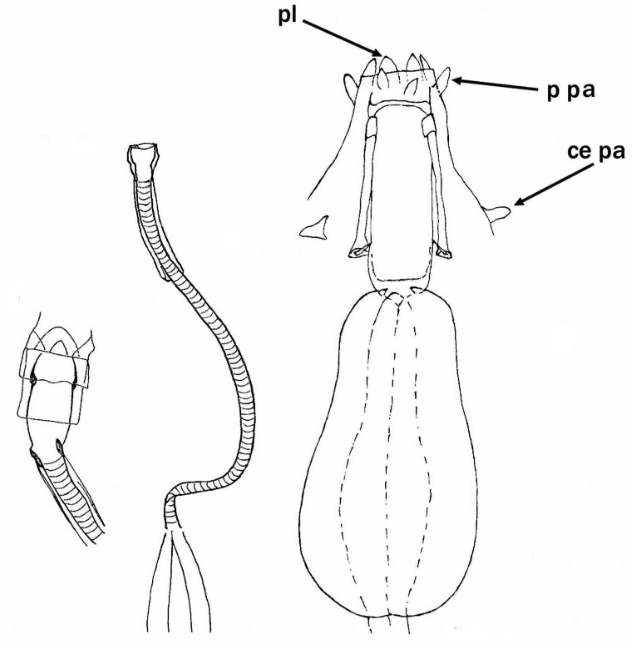
Pharyngeal tube flexible?

Note: in a tardigrade with snout extended, the flex of the pharyngeal tube may not be obvious.


Images from Pilato G, Binda MG. 2010. Definition of families, subfamilies, genera, and subgenera of the Eutardigrada, and keys to their identification. Zootaxa. 2404: 1-54.

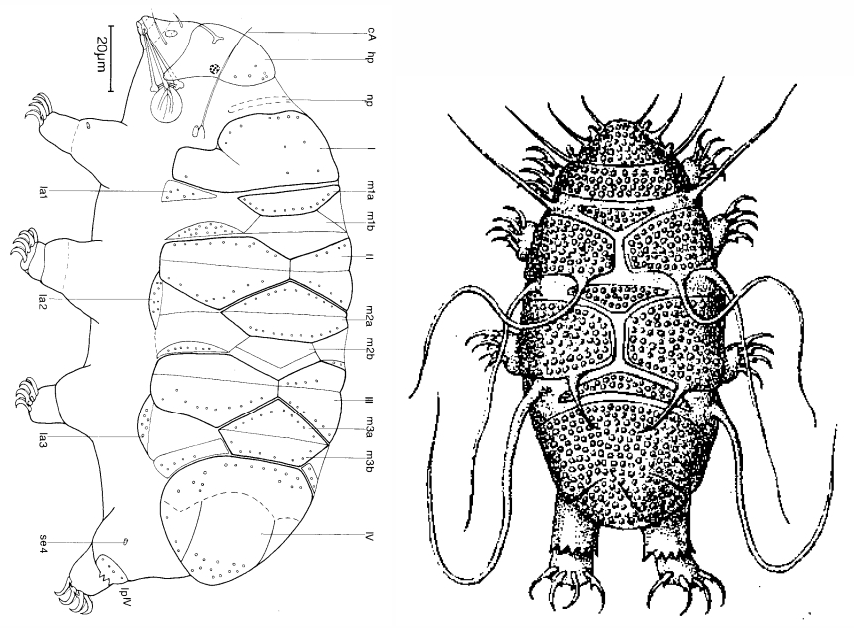
Serrated / dentate cuff / collar on legs IV

Left image from Kristensen RM. 1987. Generic revision of the Echiniscidae (Heterotardigrada), with a discussion of the origin of the family. pp. 261-335 in Bertolani R (ed). Biology of Tardigrades: Selected symposia and monographs.

Right Image from Richters F. 1926. Tardigrada. in Krumbach T. 1927. Handbuch der Zoologie, 3rd band, Walter de Gruyter & Co.

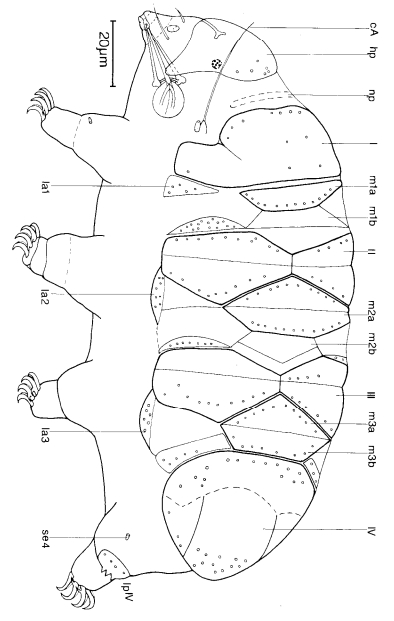
Leg sensory structures

Typically papilla on leg IV (se4 in image) and variable shape on leg I


Image from Kristensen RM. 1987. Generic revision of the Echiniscidae (Heterotardigrada), with a discussion of the origin of the family. pp. 261-335 in Bertolani R (ed). Biology of Tardigrades: Selected symposia and monographs.

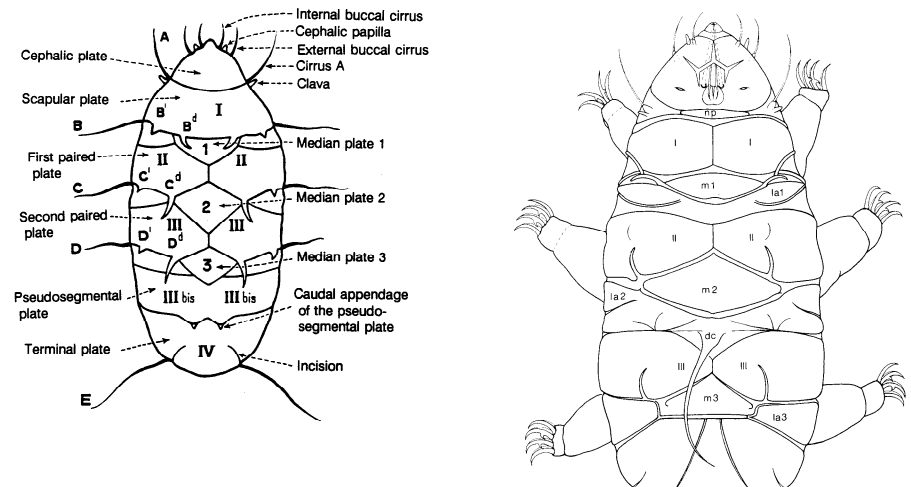
Trunk appendages

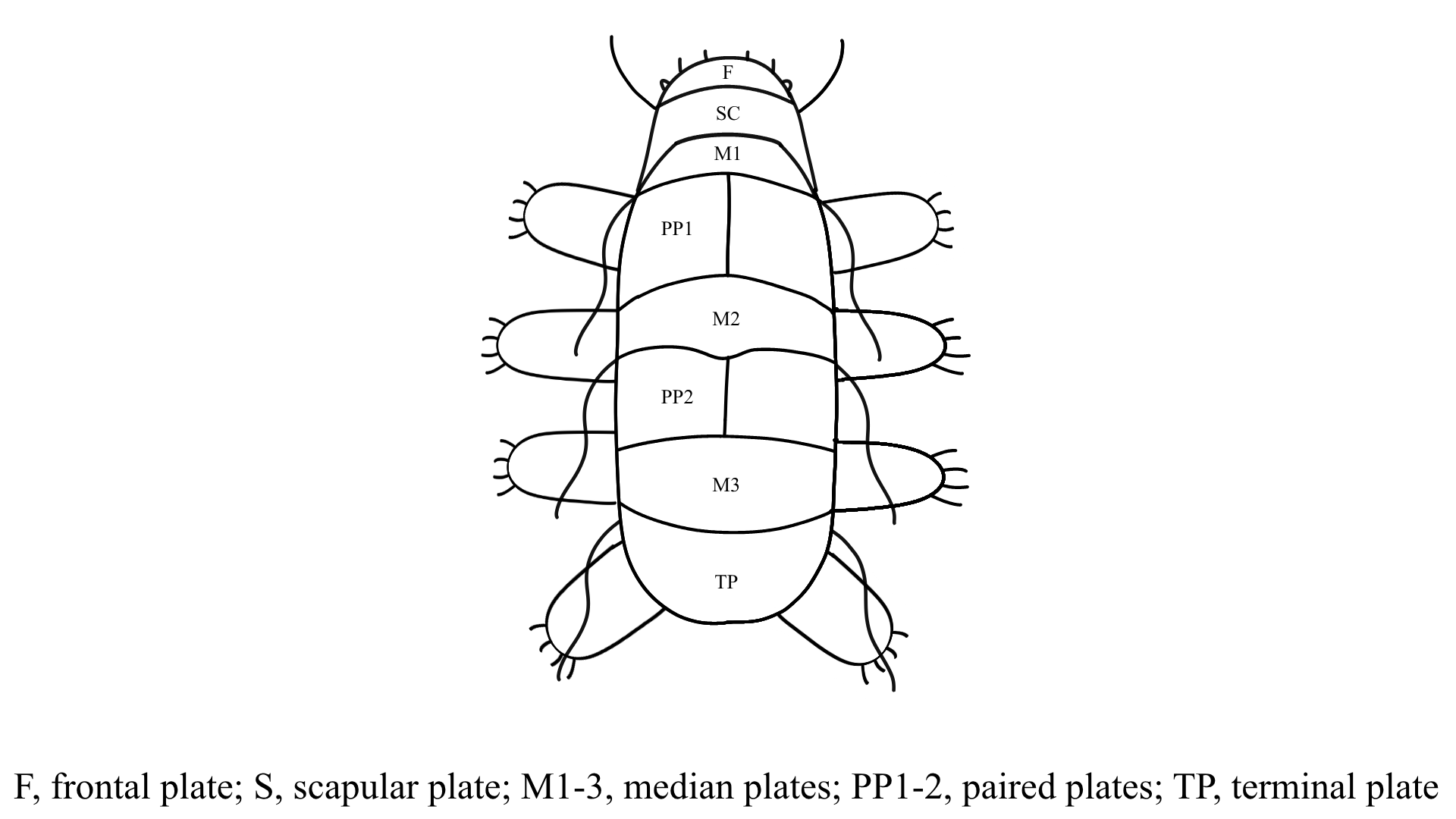
Appendages (after Cirrus A) labeled according to plate … B (Scapular plate), C (First segmental plate), D (Second segmental plate), E (terminal plate). “B” is lateral, “Bd” is dorsal

Be careful! There can be great variability within a population, with individuals (especially juveniles) lacking some appendages. When in doubt, focus on other characters first!


Left image from Ramazzotti G, Maucci W. 1983. Il phylum Tardigrada(III edizione riveduta e aggiornata). English translation by C. W. Beasley, 1995. Memorie dell’ Istituto Italiano di Idrobiologia 41: 1-1012.

Right image cropped from Kristensen RM. 1987. Generic revision of the Echiniscidae (Heterotardigrada), with a discussion of the origin of the family. pp. 261-335 in Bertolani R (ed). Biology of Tardigrades: Selected symposia and monographs.

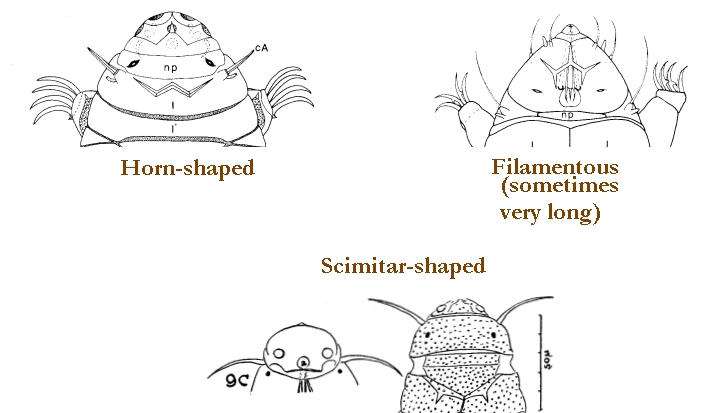
Cirrus A form

Images modified from Kristensen RM. 1987. Generic revision of the Echiniscidae (Heterotardigrada), with a discussion of the origin of the family. pp. 261-335 in Bertolani R (ed). Biology of Tardigrades: Selected symposia and monographs.

Lower image (Mopsechiniscus) modified from du Bois-Reymond Marcus E. 1944. Sobre tardigrados brasileiros. Communicaciones Zoologicas del Museo de Historia Natural de Montevideo. 1(13): 1-19 plus plates.

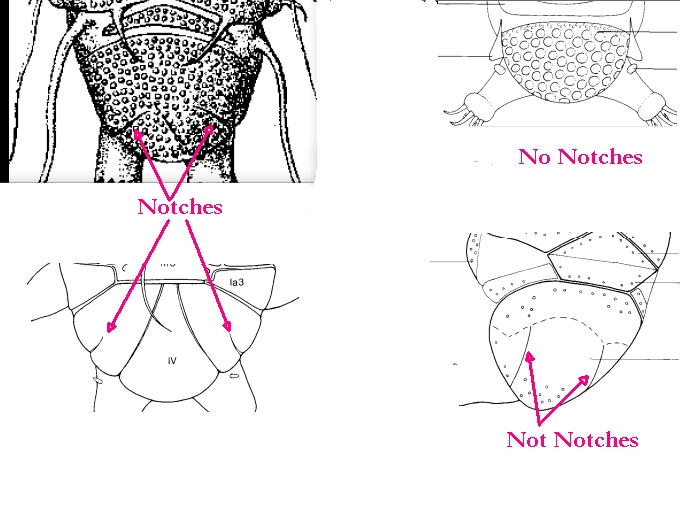
Terminal / caudal plate with two notches?

Images modified from Kristensen RM. 1987. Generic revision of the Echiniscidae (Heterotardigrada), with a discussion of the origin of the family. pp. 261-335 in Bertolani R (ed). Biology of Tardigrades: Selected symposia and monographs.

First image (Echiniscus) modified from Richters F. 1926. Tardigrada. in Krumbach T. 1927. Handbuch der Zoologie, 3rd band, Walter de Gruyter & Co.

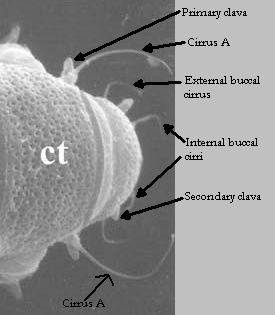
Inner & outer buccal cirri present

Image modified from Nelson DR, Guidetti R, Rebecchi L. 2009. Tardigrada. Ch. 14 in Ecology and Classification of North American Freshwater Invertebrates, Thorp JH, Covich AP (eds.), 3rd ed.

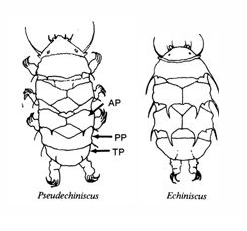
Pseudosegmental plate between last medial plate & terminal plate?

Note on 2nd image, what you see before the terminal plate is either no plate, or a full-width medial plate; don’t confuse the latter with a pseudosegmental plate!
Also, sometimes the pseudosegmental plate is paired, like segmental plates II & III. It’s still pseudosegmental!

Images from Clifford HF. 1991. Aquatic invertebrates of Alberta. University of Alberta Press, Alberta, Canada.

Segmental plates larger than intersegmental?

Image modified from Lindahl & Balser (1999), http://www.iwu.edu/~tardisdp/Keypage35.html

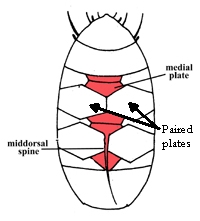
Any Paired Plates?

Modified from Lindahl K, Balser S.  1999. Key to tardigrade genera [Internet]. Available from: https://sun.iwu.edu/~tardisdp/Keypage33.html